Why we need food policy

Our current food system doesn’t serve us well. My perception is that it has evolved into an ideal money making machine – for those who have positioned themselves to harvest the economic benefits. Most of us identify the dynamic below that would seek to lock us in to dependency on big players in the food and health industries.
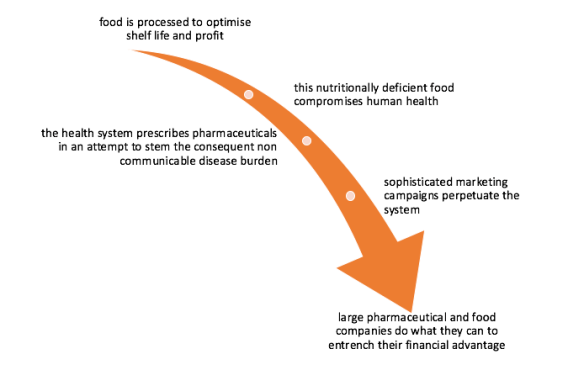
food-dysfunction

A recent report from the International Panel of Experts on Sustainable Food Systems identifies food system dynamics and advocates for a European Union Common Food Policy.

In Europe, as here, there is increasing consumer choice around food purchases, but little choice around the food systems that produce that food and deal with its consequences. Problems are exacerbated by siloed thinking, conflicting motives, disconnected policy and self-interest.

The need for new policy responses is made all the more pressing by the multiple crises now afflicting food systems in the EU and around the world, from burgeoning obesity to environmental degradation and pressures on farmer livelihoods. Our current political systems and policy frameworks are ill-equipped to address these crises. The policy tools affecting food systems do not respond to a set of agreed priorities. Instead, our food systems are the by-product of political compromises struck in various fora on the basis of various competing interests. The lack of a coherent food policy, cutting across sectors and joining up different levels of governance, means that accountability is hugely dispersed. When poor outcomes arise, no one can be held to account. With neither a pilot nor a flight plan, it is possible to ignore how badly food systems have veered off course (page 1).

The report positions this problem as a major opportunity. This resonates with our Northland experience.

Food is an entry point for joined up policymaking across multiple sectors and governance levels; sustainable food systems can provide a benchmark for actions in all of those areas. It is also a promising entry point for repairing democratic deficits and reconnecting European citizens with the policy measures put in place by their elected representatives (page 1).

The report is part of a “three year participatory process of Research, Reflection and Citizen Engagement”. With little sign of our government showing such resolve, we are at least raising awareness of the dire need for food policy reform. Please help – the first step is to engage. You can read the report here.

Joe Camuso on electric cars

Northland’s EV champion was recently interviewed by Tim Lynch on Green Planet FM.

joe-camuso-geen-planet-fm

Joe is seen around the North promoting electric vehicles, with strong support from NorthPower. His efforts are are bearing fruit as the number of EVs in northland continue to grow. You can hear his interview on the Green Planet FM website.


Managing agrobiodiversity and our conference

Professor Barbara Burlingame, professor of Public Health (Nutrition) is a keynote speaker at our conference. She has recently contributed to a chapter in Maintaining Agrobiodiversity in Sustainable Food Systems published by Bioversity International.

managing-agrobiodiversity

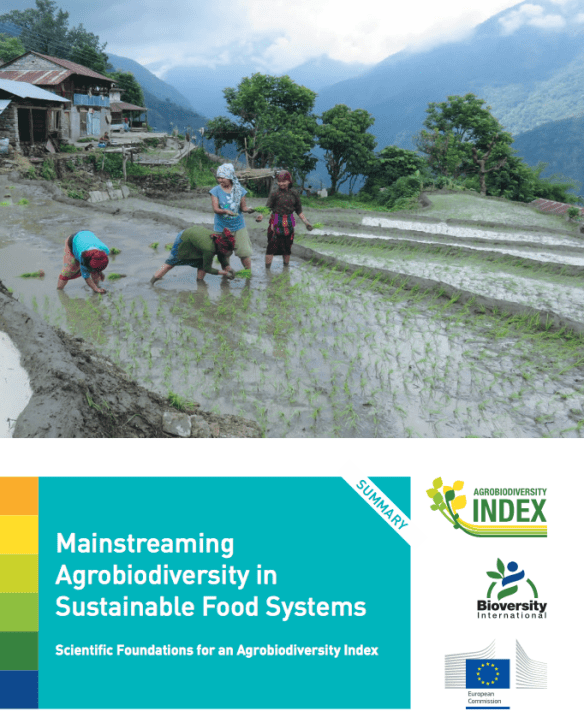
Cover of Maintaining Agrobiodiversity in Sustainable Food Systems executive summary. Photo credit: Planting rice in Nepal. Bioversity International/Sriram Subedi, LI-BIRD, Lamjung.

The executive summary of the 2017 publication is available now.

Ann Tutwiler, the Director General of Bioversity International prefaces the document by stressing the importance of linking up and learning from diverse dimensions of biodiversity.

The book is the first step in the process of creating such an index, which can measure agricultural biodiversity across different dimensions. The concept grew from the observation that juxtaposing data from very different fields connected with agricultural biodiversity can yield novel and practical insights. There is a need to measure and understand biodiversity in rapid, cost-efficient ways, going beyond just numbers, to connect also with policy decisions by countries and companies on best practices to foster diversity. Expected benefits are to be able to identify and steer opportunities for change towards sustainable food systems, and to be able to better measure and manage progress towards global targets such as the Sustainable Development Goals and the Aichi Biodiversity Targets of the Convention on Biological Diversity. Private companies and finance institutions are also interested in its applicability to measure the sustainability of investments, green bonds and company purchasing policies, while farmer organizations and consumer associations can use it to in influence programmes and policies. (page 5)

The dimensions referred to here are:

  • Diverse, healthy diets
  • Multiple benefits in sustainable farming systems
  • Seed systems delivering crop diversity for sustainable food systems
  • Conserving agricultural biodiversity for use in sustainable food systems.

Professor Burlingame contributed to chapter two, Agricultural biodiversity for healthy diverse diets. This chapter focuses on the desirability of diverse sustainable food systems delivering nutritious food to people.

bioversity

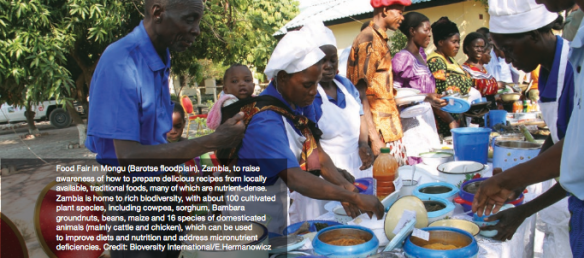
This image from chapter two shows a scene repeated around the world as communities come together to improve access and knowledge of healthy nutritious food. Its gratifying to know that in pursuing local food we are part of a global movement.

I am looking forward to learning about this from the professor.


Growing the sticky economy

The defeat of Labour leader Andrew Little’s procurement bill is another reason to have a regional food policy council. The bill, Our Work Our Future, proposed an amendment to the the Principles of Government Procurement, and the Government’s Rules of Sourcing to include two considerations, job creation and fairness.

The bill was supported by Labour, the Greens, New Zealand First and the Māori Party, but it was opposed by National, ACT and United Future. A National List MP, Paul Foster-Bell stated, “Jobs are not going to be created by trying to sell more things to ourselves,” and “And this bill is contrary to a number of our free trade agreements.”

The Government’s focus has been on driving down expenses and multinationals, with their  sophisticated systems and logistics, have been allies in that process. But if we factor in the negative externalities created by multinationals and the positive externalities created by fostering more local economic activity, any savings will prove to be minimal, or, false economy when total tax take is factored in.

The benefits of local procurement go beyond the benefits of jobs. There are social, economic and environmental benefits. Our knowledge of the food system, for example, suggests that there are diverse benefits from increasing local provision to name just a few:

  • more jobs, and therefore greater prosperity
  • reduced carbon emissions (through shorter food chains and supporting soil sequestration)
  • strengthening of rural communities.

If we look back over time, a number of multinational food service companies have arrived and established themselves here. They have significant resources to secure a foothold in local markets. One strategy is to identify key staff from local competitors and poach them, with the combined impact of reducing the local competitor’s capability and providing the newcomer with ready-made networks. If they face significant local competition, they can draw on head office for support. These multi-nationals have been seeking long contracts to embed themselves. Once they have achieved a foothold and they are the incumbents – they have an advantage in future government tenders. Thus an unlevel playing field emerges.

Fact based policy

It would be nice to think that government policy is based on evidence. Our research into the Social and Economic Impacts of the Whangarei Growers Market, reveals a 2.99 economic multiplier when local food displaces food from outside the region. This fits within a multiplier range of 2 to 4 times reported internationally. The 2.99 multiplier is based on the grower to customer transactions at the growers market, but what if we add in more complex value chains, for example, food cooked in restaurants, and that includes dry goods sourced from local or national suppliers. And what if we factor in the health benefits as we foster a greater appetite for local food?

benefits-of-local-procurement

Examples of benefits of local procurement

These multipliers are the basis of the “sticky economy” – an economy where money circulates longer locally. By contrast companies owned offshore are more likely to extract money for dividends to shareholders, head office costs and offshore suppliers. You can see a video explaining the multiplier here.

Kiwibank has a counter that calculates the quantity of bank profits lost offshore. This counter started from 28 October, 2016. You can get an update here. The total for the year to  31 March 2016 was $4.525 billion. Imagine if half of that money remained in New Zealand and we factored in the local multiplier. We don’t know how much of the Government’s $40 billion expenditure goes offshore, but with multipliers applied, this figure would be significant.

kiwibank-counter

It is very difficult to quantify these impacts in dollar terms, but the assumptions that support the rejection of this bill need to be challenged.

I am not against globalisation and regard myself as a global citizen. But the shareholder ownership structures that characterise most of the foreign companies that operate here are driven primarily to extract profits for those shareholders. Economist Shamubeel Eaqub argues for a balance between globalism and localism.

Let’s trade internationally, but do it intelligently. Enabling extractive foreign companies free reign here is not in our best interests.

Conference registration is open!

We are delighted to open our conference for registration. There is a diverse and inspiring programme including some high-profile presenters.

burlingame-palmer

These include Professor Barbara Burlingame from Massey University (left) and Anne Palmer from Johns Hopkins University.

Our conference pages provide information about the programme and has links for registration.

Please pass this on to your networks.