Localising food, climate change and the implications for food security in eastern Northland

By John Clarke
The 2016 Climate Change Projections for NZ  predict that the eastern half of Northland will experience hotter, drier summers with less winter rain and frosts. Droughts will become more common, as will extreme weather events. Relative humidity will decrease and evapotranspiration will increase. I believe that planning our landscapes to meet these changes will increase our chances of successfully localising our food supply.
Recently there has been interest in developing a tropical fruit industry in Northland. I suggest that by adopting mixed plantings of alley crops on contour with appropriate soil building techniques (such as the Yeoman’s plough on contour), water harvesting techniques (such as swales and vetiver grass), and minimisation of soil cultivation through direct reseeding, I believe that we can reduce risks while maximising production, minimising input costs, maximising soil water absorption, minimising evapotranspiration, and reduce stress on aquifers (from pollution and overuse).
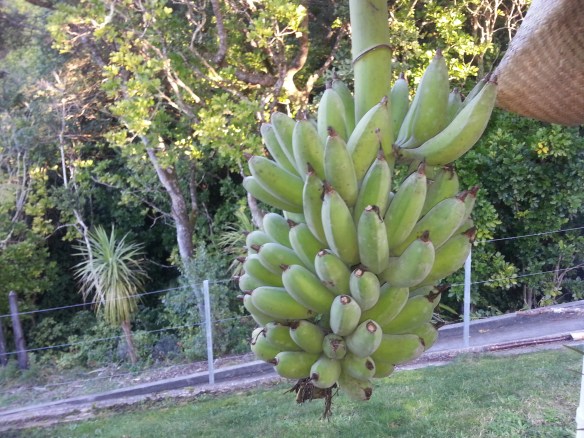
For instance, monoculture banana plantations are decimated by extreme weather events. The world’s main banana crop, the Cavendish, is under threat from the Panama disease fungus which already exists in Australia and there is no known treatment. Therefore, developing a banana monoculture industry would seem high risk. An alternative would be to form landscapes that maximise water collection at swales and on-farm dams (whenever we resort to aquifers for irrigating, we engage in an ultimately unsustainable agriculture). Landscape resilience could be increased by alley cropping a mixture of bananas on contour with an Alan Savory style livestock grazing system and further refine that with multi-species grazing. This would build soil organic matter rapidly and even more so with annual use of a Yeoman’s plough. Nutrient, microbe and water holding capacity of the soil could be enhanced by the addition of biochar and avoidance of soil cultivation.
To increase the protection of the banana crops to strong winds and evapotranspiration, alternate alleys could be planted with trees crops, and banana alleys could be interspersed with nitrogen fixing trees such as honey locust. The bananas (which would ideally be planted in the damper ground below swales) could be planted with taro, and probably within 5 years, with ginger and turmeric.
A mixed cropping landscape would increase food security by better enabling a yield in years of extreme weather.
The photograph of Mike Shepherd’s New Forest Farm below, is an example of the way a farm can be designed to withstand climate change and extreme weather while providing a wide range of yields.
newforestfarm

The nutritional value of local bananas

Professor Barbara Burlingame provided a compelling case study about the nutrient content of local bananas at our February conference. Before returning to New Zealand she spent 16 years with the UN’s Food and Agriculture Organisation including the last four as Deputy Director of the Nutrition Division as was closely involved with the research referred to here.

Professor Burlingame related the story of Pohnpei, a Micronesian Island north of the equator. Over time the people their drifted away from their indigenous diet to consuming increasing quantities of imported food. There were consequences.

The change in food habits from fresh traditional foods to processed imported foods has been accompanied by high prevalence of overweight, obesity, diabetes, heart disease and cancer among the adult population, while micronutrient deficiencies, such as of vitamin A, are prevalent among children[1].

Well intentioned interventions

Starting in the 1960s, the United States Department of Agriculture (USDA) initiated supplementary feeding programmes to Pohnpei, using surplus commodities such as rice and tinned foods. These food aid programmes, including a school lunch programme, “introduced rice and processed foods to many children and adults in Pohnpei, establishing new food habits, attitudes and food tastes that persist today”[2].

In a story similar to that of other indigenous communities transitioning from the food systems they controlled to Western diets, the unintended consequences, especially the vitamin A deficiency, sparked further inteventions. Vitamin A supplements, including injections, were provided for children.

Karat banana

The Karat banana, often the first sold food for Pohnpei’s babies. (Photo from Web Ecoist)

Researchers, led by the late Dr Lois Englberger, turned their attention to local foods. Pohnpei has 26 banana cultivars. One of these, Karat, has deep yellow/orange flesh indicating the presence of provitamin A carotenoids.

When analysed for its nutrient profile, the Karat cultivar provided up to 2230 units of carotenes. Another cultivar, Utin Lap has up to 8508 units of carotenes. By contrast, Cavendish, the variety found in supermarkets around the world has less than five units of carotenes. The answer to the debilitating vitamin A deficiency was close by all that time. Consequently the government of the Federated States of Micronesia championed the local food movement and when Dr Englberger died in 2011, they held a memorial service in her honour.

Nutrition of Northland bananas

The health of our food can be evaluated by the nutrients it provides and the impact of artificial chemicals used in its growing, processing, transportation and storage and impacted by the way we cook it.

This website provides detailed coverage of bananas’ food value.

Fruits and vegetables with orange or red flesh are rich in carotenes, so we can anticipate that our locally grown bananas will be closer to the levels found in Cavendish bananas. However, it will be interesting to have the analysis done. Perhaps we could crowdsource funding for this to support the development of the local banana industry.


[1] Let’s go local! Pohnpei promotes local food production and nutrition for health in Indigenous people’s food systems & well-being (2013) Food and Agriculture Organization of the United Nations, page 195). http://www.fao.org/docrep/018/i3144e/i3144e00.htm

[2] ibid, page 194


Banana maths – a Northland banana industry?

What would a Northland Banana Industry be worth to the local economy? Bananas are starting to appear regularly at the Whangarei Growers Market.

Consumption per person per year (kgs)[1] 18
Northland population[2] 171,400
Total banana consumption (kgs) 3,085,200
Price per kilo[3] $2.99
Total cost of bananas consumed in Northland $9,244,748

There are many variables to consider to refine these numbers, but they act as a reference point.

Bananas at home

Earlier studies reveal that produce grown locally rather than imported into the region (and country in this case) create a 2 to 4 times multiplier in both jobs and dollars. The report, The Social and Economic Impact of the Whangarei Growers Market identified the multiplier at 2.99. This work was done by economist Dr Warren Hughes.

So let’s be conservative and aim to supply 10% of Northland’s bananas, 300,000 kgs or 300 tonnes by 2025. The nearby Auckland market could probably take all we could produce.

Targeted production (kgs) 300,000
Price per kilo $4.00
Total cost of Northland produced bananas $1,200,000
Multiplier 3
Value of the Northland banana industry $3,600,000

Currently, local bananas are selling for more like $8.00 a kilo, but as production increases we can anticipate the price reducing – so these estimates are conservative.

Realising this $3.6 million industry would be challenging. Bananas required frost free locations. They can handle light infrequent frosts and surely we have plenty of microclimates where we could grow them. It would also require a significant number of banana plants to be propagated. Perhaps tissue culture is a solution.

The other requirement would be for roughly 10% of Northlanders to buy Northland bananas exclusively – this is an appealing challenge, because it provides an opportunity to support the local industry and to access a product that is much healthier.


[1] Bananas top the list of Trolley items. (26.02.2017) Kirsty Wynn. NZ Herald. Retrieved http://www.nzherald.co.nz/lifestyle/news/article.cfm?c_id=6&objectid=11805447

[2] Northland Region. Wikipedia https://en.wikipedia.org/wiki/Northland_Region. Population at June 2016

[3] Sourced from Countdown online on 5 March 2017. https://shop.countdown.co.nz/#url=/Shop/SearchProducts%3Fsearch%3Dbanana%2Bfresh

A successful conference!

Our inaugural conference was a great success… so far. We believe it was the first Northland event to bring together people from diverse interests in food production, distribution, consumption, diet and health, hospitality and education specifically to focus on the move towards more sustainable food systems.

powhiri

The opening powhiri at Te Punu o te Mātauranga and welcome from our Mayor, Sheryl Mai, set the scene. We have the great bounty of presentations from visiting experts – Anne Palmer from Johns Hopkins University and Professor Barbara Burlingame from Massey University.

The benefits of connecting with other people that share aspirations towards a stronger local food economy was a common focus of feedback of those attending. Since the conference, there has been a continuation of discussions in Loomio and further connections made. Channel North is in the process of creating a range of videos about the conference and these will be available here soon.

A feature of the conference was the superb food, mostly sourced locally and beautifully cooked and presented by Ian Sturt and his team.

For the conference to be judged a success, we will need to be able to look back at the end of the year and see significant progress on the goals currently being formulated.

Thanks to our sponsors, enabling us to keep the cost of the conference affordable. NorthTec provided the venue and great support, Northland Inc supported our planning and organised for Channel North to film the event. Thanks to the Far North District Council and Te Tai Tokerau PHO for support through the Kai Ora Fund. And thanks to all of the cafes, restaurants and food sellers that supported with food. Please support the business that support local food – there logos are below.

conference-sponsors

Permadynamics – New Zealand’s largest plantation

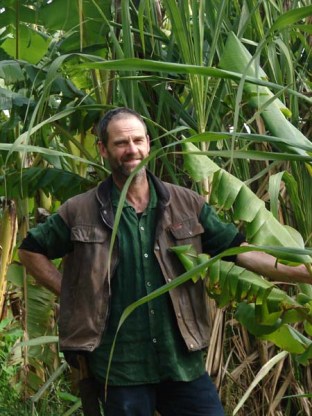
Permadynamics has the largest banana plantation in New Zealand: over 200 productive clumps, each of which produces between 60 and 70 kilos of fruit per year. Klaus Lotz and his family primarily grow Ladyfinger bananas (aka Misi Luki), but they also grow a smaller tangier Cavendish-like variety known as Goldfinger.

This post is based on an article written in Organic NZ Magazine written by Theresa Sjoquist. The article is also reproduced on this website to compile a resource on banana growing in Northland.

klaus-lotz-in-banana-plantation-at-permadynamics


Klaus Lotz of permadynamics among his bananas

The local motive

Thanks to all of those who attended our conference. It was all about supporting the shift to sustainable food systems, characterised by strong integration of health systems and primary production systems.

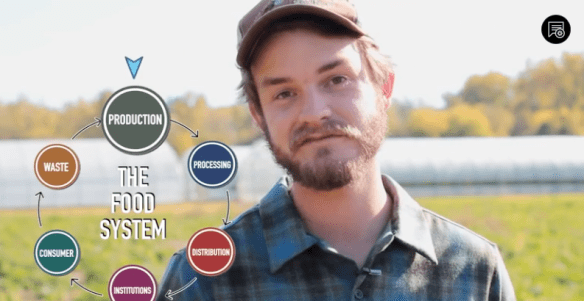
We drew on the experience of those in the state of Vermont in the U.S. While it has a colder climate than ours, and a shorter growing season, there are strong similarities. Vermonters have produced a series of videos, The Local Motive, outlining the challenges and successes in moving toward a sustainable food system. The first is Production. It addresses the challenge of supporting those who aspire to establish new farms or gardens or growing existing enterprises. What is evident is a rich network of support for those that grow food.

Here is a link to the video and others in the series.

the-local-motive


Food hubs

At our Local Food Northland Conference, we have a panel on food hubs. Most Northlanders don’t have direct experience of food hubs, so this video from Farm to Institution New England illustrates how food hubs can support the development of local food production, the downstream economy and jobs, and consumers.

Why we need food policy

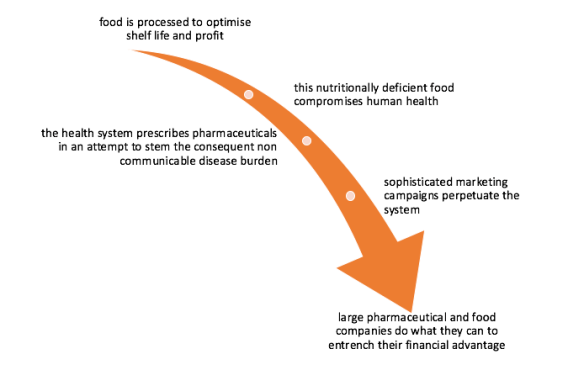
Our current food system doesn’t serve us well. My perception is that it has evolved into an ideal money making machine – for those who have positioned themselves to harvest the economic benefits. Most of us identify the dynamic below that would seek to lock us in to dependency on big players in the food and health industries.

food-dysfunction

A recent report from the International Panel of Experts on Sustainable Food Systems identifies food system dynamics and advocates for a European Union Common Food Policy.

In Europe, as here, there is increasing consumer choice around food purchases, but little choice around the food systems that produce that food and deal with its consequences. Problems are exacerbated by siloed thinking, conflicting motives, disconnected policy and self-interest.

The need for new policy responses is made all the more pressing by the multiple crises now afflicting food systems in the EU and around the world, from burgeoning obesity to environmental degradation and pressures on farmer livelihoods. Our current political systems and policy frameworks are ill-equipped to address these crises. The policy tools affecting food systems do not respond to a set of agreed priorities. Instead, our food systems are the by-product of political compromises struck in various fora on the basis of various competing interests. The lack of a coherent food policy, cutting across sectors and joining up different levels of governance, means that accountability is hugely dispersed. When poor outcomes arise, no one can be held to account. With neither a pilot nor a flight plan, it is possible to ignore how badly food systems have veered off course (page 1).

The report positions this problem as a major opportunity. This resonates with our Northland experience.

Food is an entry point for joined up policymaking across multiple sectors and governance levels; sustainable food systems can provide a benchmark for actions in all of those areas. It is also a promising entry point for repairing democratic deficits and reconnecting European citizens with the policy measures put in place by their elected representatives (page 1).

The report is part of a “three year participatory process of Research, Reflection and Citizen Engagement”. With little sign of our government showing such resolve, we are at least raising awareness of the dire need for food policy reform. Please help – the first step is to engage. You can read the report here.

Joe Camuso on electric cars

Northland’s EV champion was recently interviewed by Tim Lynch on Green Planet FM.

joe-camuso-geen-planet-fm

Joe is seen around the North promoting electric vehicles, with strong support from NorthPower. His efforts are are bearing fruit as the number of EVs in northland continue to grow. You can hear his interview on the Green Planet FM website.


Managing agrobiodiversity and our conference

Professor Barbara Burlingame, professor of Public Health (Nutrition) is a keynote speaker at our conference. She has recently contributed to a chapter in Maintaining Agrobiodiversity in Sustainable Food Systems published by Bioversity International.

managing-agrobiodiversity

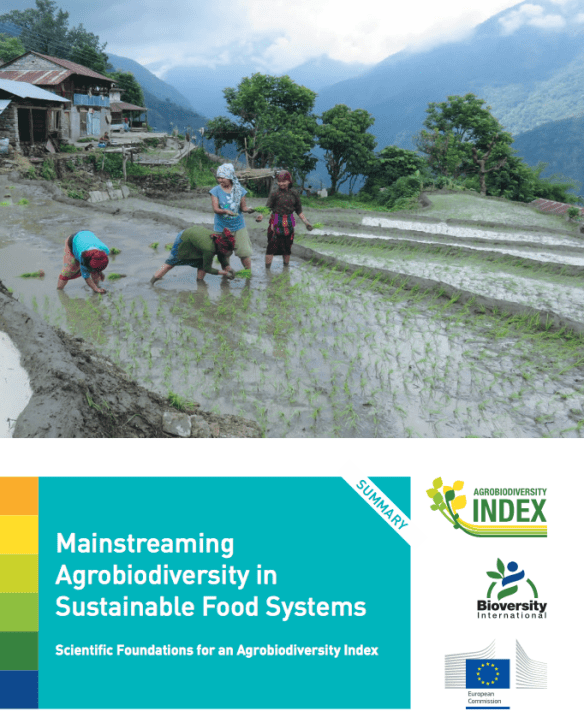
Cover of Maintaining Agrobiodiversity in Sustainable Food Systems executive summary. Photo credit: Planting rice in Nepal. Bioversity International/Sriram Subedi, LI-BIRD, Lamjung.

The executive summary of the 2017 publication is available now.

Ann Tutwiler, the Director General of Bioversity International prefaces the document by stressing the importance of linking up and learning from diverse dimensions of biodiversity.

The book is the first step in the process of creating such an index, which can measure agricultural biodiversity across different dimensions. The concept grew from the observation that juxtaposing data from very different fields connected with agricultural biodiversity can yield novel and practical insights. There is a need to measure and understand biodiversity in rapid, cost-efficient ways, going beyond just numbers, to connect also with policy decisions by countries and companies on best practices to foster diversity. Expected benefits are to be able to identify and steer opportunities for change towards sustainable food systems, and to be able to better measure and manage progress towards global targets such as the Sustainable Development Goals and the Aichi Biodiversity Targets of the Convention on Biological Diversity. Private companies and finance institutions are also interested in its applicability to measure the sustainability of investments, green bonds and company purchasing policies, while farmer organizations and consumer associations can use it to in influence programmes and policies. (page 5)

The dimensions referred to here are:

  • Diverse, healthy diets
  • Multiple benefits in sustainable farming systems
  • Seed systems delivering crop diversity for sustainable food systems
  • Conserving agricultural biodiversity for use in sustainable food systems.

Professor Burlingame contributed to chapter two, Agricultural biodiversity for healthy diverse diets. This chapter focuses on the desirability of diverse sustainable food systems delivering nutritious food to people.

bioversity

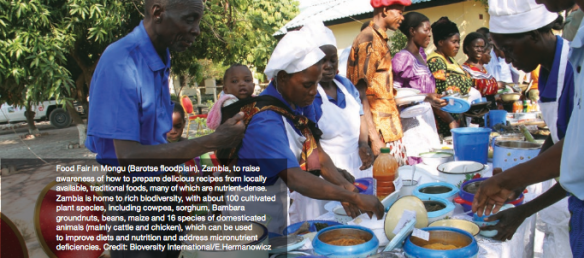
This image from chapter two shows a scene repeated around the world as communities come together to improve access and knowledge of healthy nutritious food. Its gratifying to know that in pursuing local food we are part of a global movement.

I am looking forward to learning about this from the professor.