Here is a short video from Loading Docs featuring the Gocks and their story as refugees. When kumaras in the Northern Wairoa were afflicted with black rot, Joe and Fay Gock provided new disease free kumara from their Mangere farm.
Hear more about them from this Radio New Zealand podcast. This is a timely story about the positive influence of refugees in the country that gave them a fresh start.
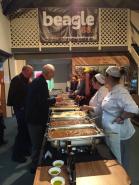
On Wednesday evening, 20th July over 120 people gathered at 116 Bank St (Company of Giants venue) in Whangarei to celebrate local food and good company.
The event was organised by Sean and Rowan Stanley of the Whangarei Food Co-op. The cost of $30/person was an amazing bargain considering the quality (and quantity!) of the food, consisting of a large variety of dishes from Whangarei chefs showcasing our delicious local food!
During the banquet we heard presentations from growers, chefs, charities and local foodies as well as live music and skits. Clive also presented part of our vision for Local Food Northland.
The idea is that this becomes at least an annual (if not seasonal) event.
(photos by Chris Schreuder, Ian Sturt and Clive McKegg)
The choice is becoming starker as we learn more about the impacts of industrial food delivered through long food chains. Do we want to support industrial food delivered through long food chains or sustainable food systems closer to home? This is the first of a series of extracts from Our Food Story. But first, here is Pete Russell personalising the shift from a long food chain to a food web advocate.
Food chains are the food system manifestation of supply chains. Globalised food chains are long food chains (LFC), while localised food chains are short food chains (SFC).
Short food chains
SFCs generate closer relationships between producers and consumers enabling the re-socialising of food. SFC offer consumers food with known provenance and enhanced quality. Critically, SFCs open opportunities for revitalising rural communities (Marsden, Banks, & Bristow, 2000). Face to face interactions between producers and consumers collapse the power-differences inherent in complex, globalising LFCs. (Feagan, 2007). Continue reading →
Today Our Food Story, an investigation into Northland’s food system is being published. It surfaces a compelling vision of the benefits accruing from a more connected and local food system. The executive summary from the document is reproduced below.
Thank you to my co-researcher Eloise Neeley for her superb work over summer to enable this report to happen.
Executive summary
We all eat it, and food has been fundamental to our economies for millennia. This report reveals opportunities to reshape our local food system with strong economic and social benefits. It is difficult to think of another industry as pervasive as the food industry. On the production side, it provides an economic base across our region, rather than being concentrated in Whangarei and Northland’s towns. On the consumption side it feeds whanau, but also patients in health facilities and customers in cafes, restaurants and hotels.
We are currently far from optimising the potential of the food system. Food distribution is dominated by corporations who primarily operate here to extract dividends for their shareholders, rather than support a “sticky economy”. Fast Food chains (also here to extract dividends) and supermarkets sell food that is often nutritionally deficient generating a plethora of diet based disease. The average weekly spend of New Zealand households is $61.90 on alcoholic beverages, tobacco and ready to eat foods, but only $22.60 on fruit and vegetables. Shifting this equation even minimally will have positive impacts.
This report focuses on food produced for local consumption. It integrates data from desktop research and interviews of 32 people involved in food production, consumption and outlets. It reveals opportunities to improve returns to growers while creating a stronger value proposition for food outlets. There are also exciting opportunities for added value processing. Data from two U.S. locations identify actual and potential new jobs generated by a re-invigorated local food system equating to between 233 and 477 jobs for Northland. The economic benefit of substituting 20% of produce imported into the region with local food sold through local food distributors and outlets, this would equate to additional economic benefits of $27.7 to $55.4 million annually for Northland.
The synergies between employment and enterprise generation, social cohesion and the potential to revolutionise positive health outcomes remain largely unexplored in Northland centres. We offer this report as a platform to generate momentum towards a more robust food system.
Our recommendations are:
Investigate the feasibility of food hubs in Whangarei and other Northland Centres.
Convene a regional discussion on the local food economy.
Stevia (Stevia rebaudia) is a great addition to any Northland garden. Although the plant is of tropical South American origins, it grows well here. It is a perennial that dies back in Winter, but in my garden, regrows every spring. The plants can handle some frost, so most Northland sites are okay. In these situations the Stevia.net website recommends recommends cutting the plants back to 100mm of stem to set them up for next season’s growth.
Bees love the white flowers that appear in mid-Autumn.
Health benefits
Refined white stevioside, extracted from leaves is hundreds of times sweeter than sugar. The leaves contain about 10% stevioside. This level intensifies as the growing season progresses.
Remarkably, stevia not only is free from the downsides of sugar, it can also remediate some of the problems associated with sugar. This page from the Greenmedinfo website references studies that reveal the efficacy of stevia in treating type 1 and 2 diabetes, hypertension and other health issues. One study identifies anti-inflammatory and antitumor properties.
This article, advises that green leaf stevia is the best option. As products become more processed, there is more potential to reduce benefits, or to generate harm. The author ranks stevia as his third preference as a sweetener after raw honey and dates. There are some cautions about side effects from using stevia.
Eating stevia
I use stevia in smoothies and salads. As I forage around the garden for salad ingredients, stevia is a favourite choice. The leaves have a slightly bitter after-taste when consumed alone, but in a salad they provide a sweet burst of flavour that really compliments the bitter flavours from salad greens.
This video explains the harvesting and drying process.
The local food movement is active internationally and nationally, but to our knowledge, in New Zealand there is limited national engagement.
Local food initiatives are proliferating globally and offer significant economic, social and environmental gains for communities.
Growers continue to suffer from food chains dominated by international distribution and retail companies. Smaller growers are marginalised and, in Northland we have noticed older growers are often not replaced when they retire. Thankfully the farmers market movement and cooperatives offer some hope and have fired interest in local food. International experience reveals that replacing imported food with local food, creates a two to four times economic multiplier with similar increases in employment levels. A richer food ecosystem develops enabling new growers to emerge and collaboration around value add projects.
This video about Vermont’s “farm to plate” initiative identifies what can be achieved here through greater engagement and collaboration.
Better health outcomes are another outcome of a more vibrant local food system (also covered in this video). Over time, people will get better access to fresh food and less dependent on processed food.
Why engage nationally?
It could be argued that communities or regions with stronger local food systems may disadvantage their neighbours. But we can anticipate that a enhancing local food systems will strengthen the hand of local growers, distributors and outlets and loosen the grip that multinational companies have on production, distribution, food retailing and fast food chains. The current dairy crisis also illustrates the importance of diversifying production and marketing channels.
Consistent with of our mode of operation to date, we are not anticipating specific outcomes from better national engagement, as these will be an outcome of the engagement, but we do anticipate the identification of synergies, with a consequent optimisation of the resources available to us. The resulting collaboration will provide another strong voice to influence policy decisions of local and central government.
How can we collaborate?
We want to identify community thought leaders in every region, health district and TEI in New Zealand. NorthTec is supporting this initiative as a research project.
Stage one of the project will create a database of local food thought leaders across the nation. Contact details are sought for:
at least 32 people (growers, food processors, schools and community), representing all 16 regions
20 people, either a Board member, or senior staff member from each of the 20 District Health Boards or other health organisations
at least 15 researchers and/or academics from the 29 universities, polytechnics and wananga.
In stage two these contacts will be surveys to explore opportunities for collaboration. The resulting report will be fed back as a draft to respondents for comment and as a basis for further engagement and project development.
If you are interested, please comment below. We also welcome recommendations of others who are thought leaders in local food.









 Local Food Northland