Here is the final version of Relocalising our Food. Thanks to all of those who helped shape the thinking in this document. Jeff, Clive and I are continuing to work on pursuing the outcomes envisioned here.


Here is the final version of Relocalising our Food. Thanks to all of those who helped shape the thinking in this document. Jeff, Clive and I are continuing to work on pursuing the outcomes envisioned here.
I grew up in the most urban of environments. We didn’t have land. We didn’t grow things. Most of my life I couldn’t understand the pleasure in gardening. Recently, I’ve begun to change. I got there through food. You see, my partner and I love to eat and we are enthusiastic cooks. I guess It finally dawned on me that, for me, gardening is about growing food in our lush Northland soil and climate.
This year I bravely planted seeds (rather than purchased seedlings) for the first time. Some seeds were commercial. Others I got from the Heritage Food Crops Research Trust in Whanganui. I heard their research director, Mark Christensen, on radio and contacted him. They work with heirloom seeds that produce highly nutritious plants. I especially enjoyed Janet Bradbury’s delightful children’s book created for the Research Trust, Jessica and the Golden Orb. It’s about growing golden tomatoes and is available as a free download. The book advised planting borage near your tomatoes to attract bees. They pollinate both the borage and the tomatoes. I found borage at Northland Plants in the Whangarei Grower’s Market and now watch bees buzzing from one borage plant to the next. When the basil seeds in the garden didn’t sprout (I don’t think I gave them enough water) I planted basil intended for eating. The roots were still attached and the basil thrives near the tomatoes.

In addition to tomatoes and a few beans. I am also growing parsley, basil and chives in pots from seed. What surprises me is my intense emotional involvement with these plants. People describe me as reserved. OK, I don’t wear my heart on my sleeve.
But it seems I do wear my heart on my garden gloves. Before my seeds sprouted, I checked them many times a day (yes I really do have a life!) When some of the tomato plants got blight after heavy rains I leapt onto the internet to find a natural cure, exactly as I would do if my partner took ill. I’ve done some serious surgery and several rounds of spraying with a baking soda mixture to save them. Perhaps my feelings will level out as I lose my novice status. Right now, it’s a tumultuous ride. My fondest hope is that the tomatoes that are on the healthy vines will ripen into golden orbs. Who’d have guessed back in my youth in the concrete jungle?
There are restaurants and cafes around Northland that choose to support local producers, but do you know who they are? And if you did know, would you be more likely to choose them to dine with?
There are a surprising number of local restaurants and cafes that are passionate about local food, but they are not communicating their passion to their customers. Perhaps we could initiate an “eat fresh, eat local” certification that local chefs could display to communicate their love for local food. Sean Stanley of the Northland Natural Foods Coop is working on a logo. Conscious Consumer, based in Wellington, has a certification process based on a series of badges including local, recycling, organic, free range etc. But the process is expensive.
To get something going up here, I favour a single qualifier – based on the percentage of food obtained from local producers. Given that there is produce not available in sufficient volumes, such as mushrooms and bananas, what do you think would be a fair threshold to qualify – 80%? When the certification is established perhaps a badge system can be added.
Shiraz restaurants would certainly qualify. Owner Jas Singh can be seen at the Whangarei Growers Markets most Saturdays buying.
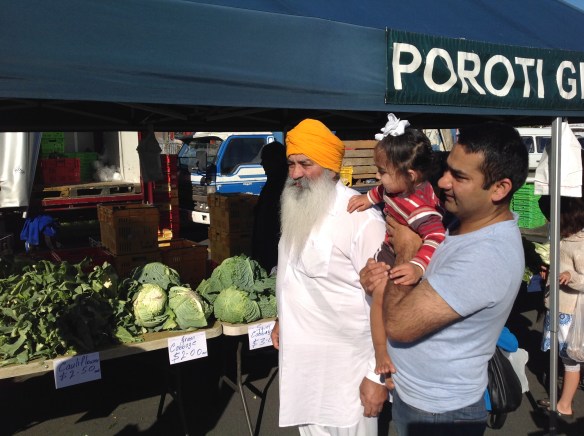
He purchases sufficient produce for the whole week and cool stores it back at his restaurant. He knows it will still be in great shape by the end of the week, because it is fresh when he buys it. If he runs short, the growers will top him up during the week.
Judy Wicks, of Philadelphia’s White Dog Café, is a pioneer of local food revival. The food in her café’s comes with a story – she knows the people that produce the veggies, fruit, meat and seafood on the menu. She articulates her vision here? We can do this too. What do you think?
We are promoting a sustainable food system for Northland.
Sheri Flies… says that three essentials must be considered in order to move the food system towards sustainability. “The first thing is that you have to have a critical mass of benevolent demand on the side of the customers. Then you need full economic, social, and ecological transparency across the entire supply chain. And then you need to give a face to the producers, to the farmers; you need to personalise their connection with the consumers, which in turn will strengthen the benevolent demand for high-quality products and processes”.[1]
Lets look at each of these essentials.
The success of the Whangarei Growers Market (WGM) evidences momentum towards a “critical mass of benevolent demand”. The research report into the WGM revealed strong customer loyalty. Sixty percent of customers identified support for local growers as important. Thus we can extrapolate that perhaps 2,000 to 4,000 of the 3,000 to 6,000 customers that shop at the market every week can be regarded as “benevolent”. Growers and farmers markets are on the rise all around Northland.
Another evidence of customer benevolence is the rise of popularity of Fair Trade movement in Northland and world-wide. The purpose of Fair Trade is to generate more equitable returns for producers.
The distribution systems that have disadvantaged third world producers have the same characteristics as the systems that have driven many Northland producers out of business.
The traditional supply chain is often predatory. Organisations in it battle to gain dominance, and when they do, they exercise power to the disadvantage of others in the chain. At their worst players in predatory supply chains guard knowledge as a competitive knowledge and seek to extract value to their own advantage.
By contrast value chain players seek to create and share value across the chain. Transparency is vital. Tinkering with existing supply chains won’t achieve the aim of delivering value to both producers and consumers. To achieve this, we must use technology to establish transparent distribution systems. Fortunately there are already local models of this in place, including markets, where the producer sells directly to the customer and newer initiatives such as the Northland Natural Food Co-op which enables the producer to determine the sale price with a small cut for the co-op.
In the short term, a social enterprise will be a good vehicle to reform distribution systems and create transparency. Social enterprises are designed to operate commercially, but have mechanisms to ensure surpluses are returned to the enterprise or community stakeholders. Thus profit and purpose are in balance.
Building richer connections between producers and their customers is happening. Our job is to seek to understand our food systems and promote interventions that enhance these connections. And as Sherie Flies states this “in turn will strengthen the benevolent demand for high-quality products and processes”.
What do you know about the food you consume? Who benefits from your purchases? And how can you use your food dollars to generate more benefits for local producers and consumers?
[1] from Theory U: Leading From the Future as it Emerges. Otto Scharmer http://www.ottoscharmer.com/publications/executive-summaries
 Local Food Northland