What do food policy councils do?

Local Food Northland is exploring how a food policy council might work for Northland. In 2015, there were 282 food policy councils in the U.S. and Canada. We anticipate that a food policy council will complement the grass roots initiatives supporting the shift to sustainable food systems.

So what do food policy councils do? The  Center for a Livable Future Food Policy Network project, run out of John Hopkins university monitor the performance of food policy councils through an annual survey.

The image below reveals the range of achievements by food policy councils.
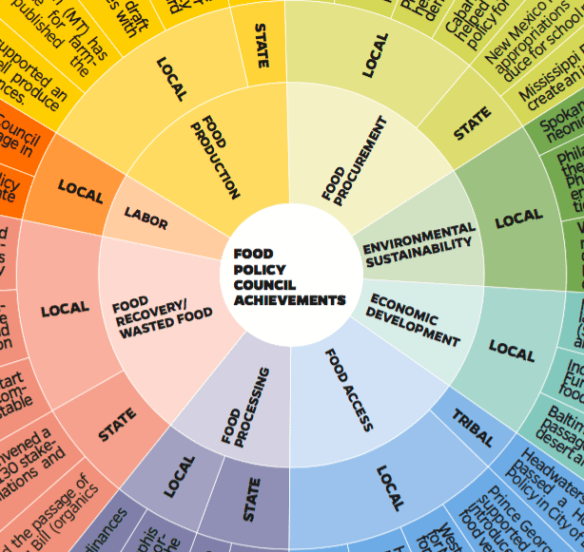
Food Policy Council activity.png

Activities include:

  • Food production including action plans, input into legislation and the retention of farm land.
  • Food procurement  with most of the activity focusing on measures to ensure increasing proportions of food for schools is healthy and locally sourced. An important initiative was promoting legislation to give preference to locally grown, processed and prepared foods. This is relevant to Northland where our DHB resisted Ministry of Health policy to have packaged meals delivered from out of region kitchens.
  • Environmental sustainability including bans on bee killing neonicotinoids, zero waste initiatives and purchasing policy supporting recycled, reusable or compostable packaging.
  • Economic development including financial incentives for local food initiatives and the provision of tax credits to support grocery stores in “food desert”locations.
  • Food access initiatives support better health.  Examples are the promotion of healthy mobile food vending legislation, promotion of the North Carolina Healthy Corner Stores Act and funding to support access to healthy food in New Orleans.
  • Food processing initiatives generally focussed on ensuring that legislation didn’t disadvantage smaller producers.
  • Food recovery initiatives support composting, food recovery and better waste reduction practices.
  • Labour initiatives focussed on raising minimum wages.

You can access the report here and its infographic here.

The United States has an advantage that legislation can be passed at local, state and federal government levels. This enables the emergence of innovative policy and regulation that can be observed and replicated by others. This contrasts with our much more centrally controlled system. So for us the solution could include keeping a close eye on international initiatives and establishing a network of food policy councils throughout New Zealand.


A Food Policy Council for Northland?

While current sustainable food system initiatives in Northland are admirable, as yet, they remain relatively poorly connected. If this were to continue, such initiatives will remain as a counter-culture in the prevailing industrial food system. Local Food Northland believe that developing a Northland food policy council, founded democratically as a “grass-roots” initiative with the task of preparing a regional food plan and fostering greater connectivity is a desirable step toward a more sustainable food system.

Here is  an extract about food policy councils from our current research.

It is not surprising that we find strong momentum towards establishing sustainable food systems in the nation that has been at the forefront of the proliferation of fast food chains, food processing and long food chains. In 2015, The United States had 215 Food Policy Councils, with a total of 282 in North America.

Screen Shot 2016-08-20 at 11.15.43 AM

Food Policy Councils in North America

This graph (from John Hopkins Center for a Livable Future) reveals dramatic growth in Councils from 2000 to 2015. Growth appears to have plateaued, but based on its proliferation in North America is primed to expand in other locations world-wide.

Seventy eight percent of these councils are either independent grass-roots organisations or NGOs with Twenty one percent embedded in government or government funded organisations (Center for a Livable Future, 2015).

The Center for a Livable Future’s mission is “to promote research and to develop and communicate information about the complex interrelationships among diet, food production, environment, and human health” (Center for a Livable Future, 2016). The top priorities for Food Policy Councils are healthy food access, urban agriculture/food production, education, purchasing and procurements, networking and food hubs. Other interests are anti-hunger, food waste and fitness(Center for a Livable Future, 2015).

Two examples of Food Policy Councils follow – the first metropolitan and the second regional.

The Toronto Food Policy Council (TFPC)

The Toronto Food Policy Council, established in 1991 is one of the oldest. The TFPC “connects diverse people from the food, farming and community sector to develop innovative policies and projects that support a health-focused food system, and provides a forum for action across the food system” (Toronto Food Policy Council, 2016).

Key documents include the Toronto Food Charter and Cultivating Food Connections, Toronto Food Strategy. The TFPC also collaborates with other organisations in Ontario to promote policy and legislation to shape a sustainable food system. Wayne Roberts (2014) uses a flywheel as a metaphor for food policy councils. They institutionalise and foster innovation providing momentum, rather than having new projects have to start unaided and poorly connected to the diversity in the food system.

Puget Sound Regional Food Policy Council (PSRFPC)

The PSRFPC is much younger, established in 2010. Its vision is a “thriving, inclusive and just local and regional food system that enhances the health of: people, diverse communities, economies, and environments”(Puget Sound Regional Food Policy Council, 2011). In addition to policy work, the PSRFPC has worked on farmers market viability.

Sustainable food systems and the UNEP

Take a look at this brilliant video from the United Nations Environmental Programme (UNEP). In under 4 minutes it provides a clear and concise evaluation of our global food system.

It is good to know that at the highest level of global governance there is awareness of the dire state of our food system. The video briefly explores solutions, notably the need to break down the silos between government and health authorities, producers, consumers and business people.

Simply identifying the food system as a system is a great start. When we are embedded in systems, often systems that we were born into, we tend to take the status quo for granted. For example my parents shopped at local grocery stores whereas I now shop at supermarkets. My children’s first experience of supermarkets were as infants – they have grown up with the phenomena.

So how do we effect change? This will be explored in future posts.

You can check out the UNEP Sustainable Food Systems Programme here. Their video was uploaded to YouTube on May 9 2016 and in 10 weeks has only had 4049 views. Please share this post or the video URL to increase circulation of these ideas.

Please also feel free to comment? How do you think we can effect change?