Localising food, climate change and the implications for food security in eastern Northland


Professor Barbara Burlingame provided a compelling case study about the nutrient content of local bananas at our February conference. Before returning to New Zealand she spent 16 years with the UN’s Food and Agriculture Organisation including the last four as Deputy Director of the Nutrition Division as was closely involved with the research referred to here.
Professor Burlingame related the story of Pohnpei, a Micronesian Island north of the equator. Over time the people their drifted away from their indigenous diet to consuming increasing quantities of imported food. There were consequences.
The change in food habits from fresh traditional foods to processed imported foods has been accompanied by high prevalence of overweight, obesity, diabetes, heart disease and cancer among the adult population, while micronutrient deficiencies, such as of vitamin A, are prevalent among children[1].
Starting in the 1960s, the United States Department of Agriculture (USDA) initiated supplementary feeding programmes to Pohnpei, using surplus commodities such as rice and tinned foods. These food aid programmes, including a school lunch programme, “introduced rice and processed foods to many children and adults in Pohnpei, establishing new food habits, attitudes and food tastes that persist today”[2].
In a story similar to that of other indigenous communities transitioning from the food systems they controlled to Western diets, the unintended consequences, especially the vitamin A deficiency, sparked further inteventions. Vitamin A supplements, including injections, were provided for children.

The Karat banana, often the first sold food for Pohnpei’s babies. (Photo from Web Ecoist)
Researchers, led by the late Dr Lois Englberger, turned their attention to local foods. Pohnpei has 26 banana cultivars. One of these, Karat, has deep yellow/orange flesh indicating the presence of provitamin A carotenoids.
When analysed for its nutrient profile, the Karat cultivar provided up to 2230 units of carotenes. Another cultivar, Utin Lap has up to 8508 units of carotenes. By contrast, Cavendish, the variety found in supermarkets around the world has less than five units of carotenes. The answer to the debilitating vitamin A deficiency was close by all that time. Consequently the government of the Federated States of Micronesia championed the local food movement and when Dr Englberger died in 2011, they held a memorial service in her honour.
The health of our food can be evaluated by the nutrients it provides and the impact of artificial chemicals used in its growing, processing, transportation and storage and impacted by the way we cook it.
This website provides detailed coverage of bananas’ food value.
Fruits and vegetables with orange or red flesh are rich in carotenes, so we can anticipate that our locally grown bananas will be closer to the levels found in Cavendish bananas. However, it will be interesting to have the analysis done. Perhaps we could crowdsource funding for this to support the development of the local banana industry.
[1] Let’s go local! Pohnpei promotes local food production and nutrition for health in Indigenous people’s food systems & well-being (2013) Food and Agriculture Organization of the United Nations, page 195). http://www.fao.org/docrep/018/i3144e/i3144e00.htm
[2] ibid, page 194
What would a Northland Banana Industry be worth to the local economy? Bananas are starting to appear regularly at the Whangarei Growers Market.
| Consumption per person per year (kgs)[1] | 18 |
| Northland population[2] | 171,400 |
| Total banana consumption (kgs) | 3,085,200 |
| Price per kilo[3] | $2.99 |
| Total cost of bananas consumed in Northland | $9,244,748 |
There are many variables to consider to refine these numbers, but they act as a reference point.

Earlier studies reveal that produce grown locally rather than imported into the region (and country in this case) create a 2 to 4 times multiplier in both jobs and dollars. The report, The Social and Economic Impact of the Whangarei Growers Market identified the multiplier at 2.99. This work was done by economist Dr Warren Hughes.
So let’s be conservative and aim to supply 10% of Northland’s bananas, 300,000 kgs or 300 tonnes by 2025. The nearby Auckland market could probably take all we could produce.
| Targeted production (kgs) | 300,000 |
| Price per kilo | $4.00 |
| Total cost of Northland produced bananas | $1,200,000 |
| Multiplier | 3 |
| Value of the Northland banana industry | $3,600,000 |
Currently, local bananas are selling for more like $8.00 a kilo, but as production increases we can anticipate the price reducing – so these estimates are conservative.
Realising this $3.6 million industry would be challenging. Bananas required frost free locations. They can handle light infrequent frosts and surely we have plenty of microclimates where we could grow them. It would also require a significant number of banana plants to be propagated. Perhaps tissue culture is a solution.
The other requirement would be for roughly 10% of Northlanders to buy Northland bananas exclusively – this is an appealing challenge, because it provides an opportunity to support the local industry and to access a product that is much healthier.
[1] Bananas top the list of Trolley items. (26.02.2017) Kirsty Wynn. NZ Herald. Retrieved http://www.nzherald.co.nz/lifestyle/news/article.cfm?c_id=6&objectid=11805447
[2] Northland Region. Wikipedia https://en.wikipedia.org/wiki/Northland_Region. Population at June 2016
[3] Sourced from Countdown online on 5 March 2017. https://shop.countdown.co.nz/#url=/Shop/SearchProducts%3Fsearch%3Dbanana%2Bfresh
Our inaugural conference was a great success… so far. We believe it was the first Northland event to bring together people from diverse interests in food production, distribution, consumption, diet and health, hospitality and education specifically to focus on the move towards more sustainable food systems.

The opening powhiri at Te Punu o te Mātauranga and welcome from our Mayor, Sheryl Mai, set the scene. We have the great bounty of presentations from visiting experts – Anne Palmer from Johns Hopkins University and Professor Barbara Burlingame from Massey University.
The benefits of connecting with other people that share aspirations towards a stronger local food economy was a common focus of feedback of those attending. Since the conference, there has been a continuation of discussions in Loomio and further connections made. Channel North is in the process of creating a range of videos about the conference and these will be available here soon.
A feature of the conference was the superb food, mostly sourced locally and beautifully cooked and presented by Ian Sturt and his team.
For the conference to be judged a success, we will need to be able to look back at the end of the year and see significant progress on the goals currently being formulated.
Thanks to our sponsors, enabling us to keep the cost of the conference affordable. NorthTec provided the venue and great support, Northland Inc supported our planning and organised for Channel North to film the event. Thanks to the Far North District Council and Te Tai Tokerau PHO for support through the Kai Ora Fund. And thanks to all of the cafes, restaurants and food sellers that supported with food. Please support the business that support local food – there logos are below.

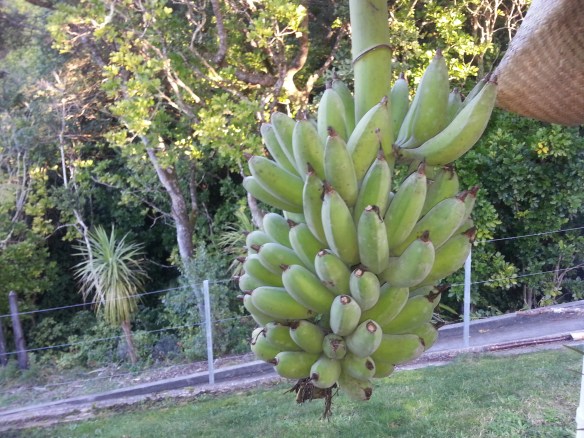
Permadynamics has the largest banana plantation in New Zealand: over 200 productive clumps, each of which produces between 60 and 70 kilos of fruit per year. Klaus Lotz and his family primarily grow Ladyfinger bananas (aka Misi Luki), but they also grow a smaller tangier Cavendish-like variety known as Goldfinger.
This post is based on an article written in Organic NZ Magazine written by Theresa Sjoquist. The article is also reproduced on this website to compile a resource on banana growing in Northland.

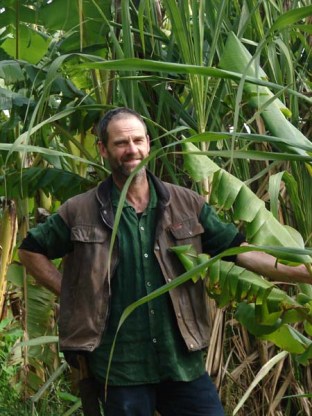
Klaus Lotz of permadynamics among his bananas
Thanks to all of those who attended our conference. It was all about supporting the shift to sustainable food systems, characterised by strong integration of health systems and primary production systems.
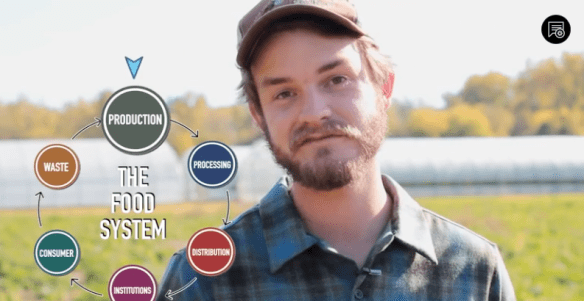
We drew on the experience of those in the state of Vermont in the U.S. While it has a colder climate than ours, and a shorter growing season, there are strong similarities. Vermonters have produced a series of videos, The Local Motive, outlining the challenges and successes in moving toward a sustainable food system. The first is Production. It addresses the challenge of supporting those who aspire to establish new farms or gardens or growing existing enterprises. What is evident is a rich network of support for those that grow food.
Here is a link to the video and others in the series.

At our Local Food Northland Conference, we have a panel on food hubs. Most Northlanders don’t have direct experience of food hubs, so this video from Farm to Institution New England illustrates how food hubs can support the development of local food production, the downstream economy and jobs, and consumers.
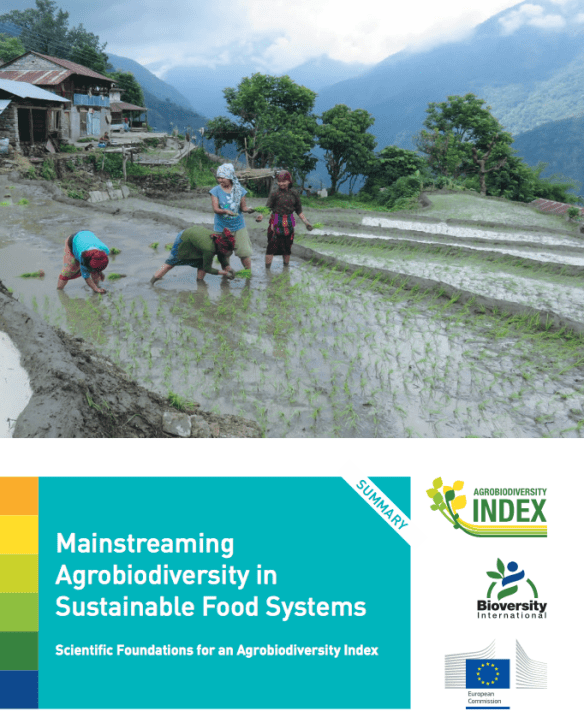
Professor Barbara Burlingame, professor of Public Health (Nutrition) is a keynote speaker at our conference. She has recently contributed to a chapter in Maintaining Agrobiodiversity in Sustainable Food Systems published by Bioversity International.

Cover of Maintaining Agrobiodiversity in Sustainable Food Systems executive summary. Photo credit: Planting rice in Nepal. Bioversity International/Sriram Subedi, LI-BIRD, Lamjung.
The executive summary of the 2017 publication is available now.
Ann Tutwiler, the Director General of Bioversity International prefaces the document by stressing the importance of linking up and learning from diverse dimensions of biodiversity.
The book is the first step in the process of creating such an index, which can measure agricultural biodiversity across different dimensions. The concept grew from the observation that juxtaposing data from very different fields connected with agricultural biodiversity can yield novel and practical insights. There is a need to measure and understand biodiversity in rapid, cost-efficient ways, going beyond just numbers, to connect also with policy decisions by countries and companies on best practices to foster diversity. Expected benefits are to be able to identify and steer opportunities for change towards sustainable food systems, and to be able to better measure and manage progress towards global targets such as the Sustainable Development Goals and the Aichi Biodiversity Targets of the Convention on Biological Diversity. Private companies and finance institutions are also interested in its applicability to measure the sustainability of investments, green bonds and company purchasing policies, while farmer organizations and consumer associations can use it to in influence programmes and policies. (page 5)
The dimensions referred to here are:
Professor Burlingame contributed to chapter two, Agricultural biodiversity for healthy diverse diets. This chapter focuses on the desirability of diverse sustainable food systems delivering nutritious food to people.

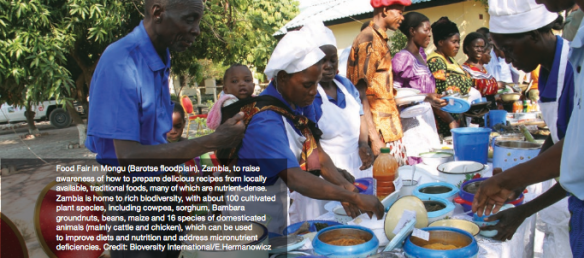
This image from chapter two shows a scene repeated around the world as communities come together to improve access and knowledge of healthy nutritious food. Its gratifying to know that in pursuing local food we are part of a global movement.
I am looking forward to learning about this from the professor.
The defeat of Labour leader Andrew Little’s procurement bill is another reason to have a regional food policy council. The bill, Our Work Our Future, proposed an amendment to the the Principles of Government Procurement, and the Government’s Rules of Sourcing to include two considerations, job creation and fairness.
The bill was supported by Labour, the Greens, New Zealand First and the Māori Party, but it was opposed by National, ACT and United Future. A National List MP, Paul Foster-Bell stated, “Jobs are not going to be created by trying to sell more things to ourselves,” and “And this bill is contrary to a number of our free trade agreements.”
The Government’s focus has been on driving down expenses and multinationals, with their sophisticated systems and logistics, have been allies in that process. But if we factor in the negative externalities created by multinationals and the positive externalities created by fostering more local economic activity, any savings will prove to be minimal, or, false economy when total tax take is factored in.
The benefits of local procurement go beyond the benefits of jobs. There are social, economic and environmental benefits. Our knowledge of the food system, for example, suggests that there are diverse benefits from increasing local provision to name just a few:
If we look back over time, a number of multinational food service companies have arrived and established themselves here. They have significant resources to secure a foothold in local markets. One strategy is to identify key staff from local competitors and poach them, with the combined impact of reducing the local competitor’s capability and providing the newcomer with ready-made networks. If they face significant local competition, they can draw on head office for support. These multi-nationals have been seeking long contracts to embed themselves. Once they have achieved a foothold and they are the incumbents – they have an advantage in future government tenders. Thus an unlevel playing field emerges.
It would be nice to think that government policy is based on evidence. Our research into the Social and Economic Impacts of the Whangarei Growers Market, reveals a 2.99 economic multiplier when local food displaces food from outside the region. This fits within a multiplier range of 2 to 4 times reported internationally. The 2.99 multiplier is based on the grower to customer transactions at the growers market, but what if we add in more complex value chains, for example, food cooked in restaurants, and that includes dry goods sourced from local or national suppliers. And what if we factor in the health benefits as we foster a greater appetite for local food?

Examples of benefits of local procurement
These multipliers are the basis of the “sticky economy” – an economy where money circulates longer locally. By contrast companies owned offshore are more likely to extract money for dividends to shareholders, head office costs and offshore suppliers. You can see a video explaining the multiplier here.
Kiwibank has a counter that calculates the quantity of bank profits lost offshore. This counter started from 28 October, 2016. You can get an update here. The total for the year to 31 March 2016 was $4.525 billion. Imagine if half of that money remained in New Zealand and we factored in the local multiplier. We don’t know how much of the Government’s $40 billion expenditure goes offshore, but with multipliers applied, this figure would be significant.

It is very difficult to quantify these impacts in dollar terms, but the assumptions that support the rejection of this bill need to be challenged.
I am not against globalisation and regard myself as a global citizen. But the shareholder ownership structures that characterise most of the foreign companies that operate here are driven primarily to extract profits for those shareholders. Economist Shamubeel Eaqub argues for a balance between globalism and localism.
Let’s trade internationally, but do it intelligently. Enabling extractive foreign companies free reign here is not in our best interests.
We are delighted to open our conference for registration. There is a diverse and inspiring programme including some high-profile presenters.

These include Professor Barbara Burlingame from Massey University (left) and Anne Palmer from Johns Hopkins University.
Our conference pages provide information about the programme and has links for registration.
Please pass this on to your networks.