Managing agrobiodiversity and our conference

Professor Barbara Burlingame, professor of Public Health (Nutrition) is a keynote speaker at our conference. She has recently contributed to a chapter in Maintaining Agrobiodiversity in Sustainable Food Systems published by Bioversity International.

managing-agrobiodiversity

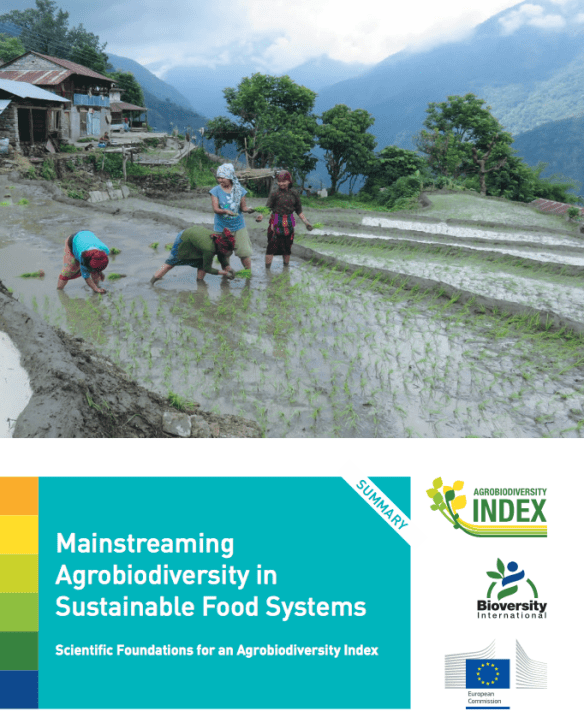
Cover of Maintaining Agrobiodiversity in Sustainable Food Systems executive summary. Photo credit: Planting rice in Nepal. Bioversity International/Sriram Subedi, LI-BIRD, Lamjung.

The executive summary of the 2017 publication is available now.

Ann Tutwiler, the Director General of Bioversity International prefaces the document by stressing the importance of linking up and learning from diverse dimensions of biodiversity.

The book is the first step in the process of creating such an index, which can measure agricultural biodiversity across different dimensions. The concept grew from the observation that juxtaposing data from very different fields connected with agricultural biodiversity can yield novel and practical insights. There is a need to measure and understand biodiversity in rapid, cost-efficient ways, going beyond just numbers, to connect also with policy decisions by countries and companies on best practices to foster diversity. Expected benefits are to be able to identify and steer opportunities for change towards sustainable food systems, and to be able to better measure and manage progress towards global targets such as the Sustainable Development Goals and the Aichi Biodiversity Targets of the Convention on Biological Diversity. Private companies and finance institutions are also interested in its applicability to measure the sustainability of investments, green bonds and company purchasing policies, while farmer organizations and consumer associations can use it to in influence programmes and policies. (page 5)

The dimensions referred to here are:

  • Diverse, healthy diets
  • Multiple benefits in sustainable farming systems
  • Seed systems delivering crop diversity for sustainable food systems
  • Conserving agricultural biodiversity for use in sustainable food systems.

Professor Burlingame contributed to chapter two, Agricultural biodiversity for healthy diverse diets. This chapter focuses on the desirability of diverse sustainable food systems delivering nutritious food to people.

bioversity

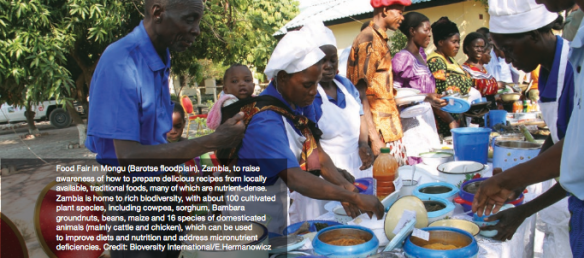
This image from chapter two shows a scene repeated around the world as communities come together to improve access and knowledge of healthy nutritious food. Its gratifying to know that in pursuing local food we are part of a global movement.

I am looking forward to learning about this from the professor.


Growing the sticky economy

The defeat of Labour leader Andrew Little’s procurement bill is another reason to have a regional food policy council. The bill, Our Work Our Future, proposed an amendment to the the Principles of Government Procurement, and the Government’s Rules of Sourcing to include two considerations, job creation and fairness.

The bill was supported by Labour, the Greens, New Zealand First and the Māori Party, but it was opposed by National, ACT and United Future. A National List MP, Paul Foster-Bell stated, “Jobs are not going to be created by trying to sell more things to ourselves,” and “And this bill is contrary to a number of our free trade agreements.”

The Government’s focus has been on driving down expenses and multinationals, with their  sophisticated systems and logistics, have been allies in that process. But if we factor in the negative externalities created by multinationals and the positive externalities created by fostering more local economic activity, any savings will prove to be minimal, or, false economy when total tax take is factored in.

The benefits of local procurement go beyond the benefits of jobs. There are social, economic and environmental benefits. Our knowledge of the food system, for example, suggests that there are diverse benefits from increasing local provision to name just a few:

  • more jobs, and therefore greater prosperity
  • reduced carbon emissions (through shorter food chains and supporting soil sequestration)
  • strengthening of rural communities.

If we look back over time, a number of multinational food service companies have arrived and established themselves here. They have significant resources to secure a foothold in local markets. One strategy is to identify key staff from local competitors and poach them, with the combined impact of reducing the local competitor’s capability and providing the newcomer with ready-made networks. If they face significant local competition, they can draw on head office for support. These multi-nationals have been seeking long contracts to embed themselves. Once they have achieved a foothold and they are the incumbents – they have an advantage in future government tenders. Thus an unlevel playing field emerges.

Fact based policy

It would be nice to think that government policy is based on evidence. Our research into the Social and Economic Impacts of the Whangarei Growers Market, reveals a 2.99 economic multiplier when local food displaces food from outside the region. This fits within a multiplier range of 2 to 4 times reported internationally. The 2.99 multiplier is based on the grower to customer transactions at the growers market, but what if we add in more complex value chains, for example, food cooked in restaurants, and that includes dry goods sourced from local or national suppliers. And what if we factor in the health benefits as we foster a greater appetite for local food?

benefits-of-local-procurement

Examples of benefits of local procurement

These multipliers are the basis of the “sticky economy” – an economy where money circulates longer locally. By contrast companies owned offshore are more likely to extract money for dividends to shareholders, head office costs and offshore suppliers. You can see a video explaining the multiplier here.

Kiwibank has a counter that calculates the quantity of bank profits lost offshore. This counter started from 28 October, 2016. You can get an update here. The total for the year to  31 March 2016 was $4.525 billion. Imagine if half of that money remained in New Zealand and we factored in the local multiplier. We don’t know how much of the Government’s $40 billion expenditure goes offshore, but with multipliers applied, this figure would be significant.

kiwibank-counter

It is very difficult to quantify these impacts in dollar terms, but the assumptions that support the rejection of this bill need to be challenged.

I am not against globalisation and regard myself as a global citizen. But the shareholder ownership structures that characterise most of the foreign companies that operate here are driven primarily to extract profits for those shareholders. Economist Shamubeel Eaqub argues for a balance between globalism and localism.

Let’s trade internationally, but do it intelligently. Enabling extractive foreign companies free reign here is not in our best interests.

Conference registration is open!

We are delighted to open our conference for registration. There is a diverse and inspiring programme including some high-profile presenters.

burlingame-palmer

These include Professor Barbara Burlingame from Massey University (left) and Anne Palmer from Johns Hopkins University.

Our conference pages provide information about the programme and has links for registration.

Please pass this on to your networks.

Why the food movement is unstoppable

jonathan-lathamIn this remarkable article Dr. Jonathan Latham outlines 5 reasons why the food movement is unstoppable:

  • it’s a leaderless movement
  • it’s a grassroots movement
  • it’s international
  • it’s low-budget
  • it’s a movement of many values.

He asks “could the food movement be the missing vehicle for transformative social change?”

His conclusion encourages those supporting the move from industrial food systems to sustainable food systems.

In the ultimate analysis, the growth of the food movement is the people’s response to the failing ideas of the enlightenment. It represents a tectonic realignment of the forces underlying our society and a clash of ideas more profound than anything seen since the collapse of feudalism and the emergence of the industrial revolution. The outcome of this clash will determine not only the future of our society, but also whether our descendants get to live on a planet recognisable to us today. The portents are excellent. The food movement is prevailing because it takes advantage of the synergies and potentials inherent in biological systems, whereas the ideas of the enlightenment ignore, deny, and suppress these potentialities. It will indeed be a beautiful struggle to turn these portents into reality.

You can read the full article here.

Dr Barbara Burlingame presenting at the Local Food Northland conference

Dr Barbara Burlingame will be presenting at the Local Food Northland conference on 13 and 14 February at NorthTec next year.

Dr Burlingame achieved her undergraduate degree at the University of California and then was awarded a PhD from Massey University. She is returning to New Zealand to take up a new role at Massey.

dr-susan-burlingame

Dr Barbara Burlingame speaking during an FAO seminar on nutrition and environmental sustainability, as part of the preparations for the Second International Conference on Nutrition (ICN2), in November 2014. Photo credit: ©FAO/Giuseppe Carotenuto

We are fortunate to have a presenter of such calibre here. She has spent the past 16 years based in Rome, working for the Food and Agriculture Organisation of the United Nations, including the last four as Deputy Director of the Nutrition Division.

The following video reveals her knowledge on nutrition, diet and sustainability – a great fit with our aspirations. You can read more about her here.

Fresh food co-op Onerahi hub

Story and photos by Jacqueline Low (thank you Jacqueline). Originally published in the September edition of the Onerahi Orbit.

Since the article was printed, the Onerahi hub has opened! And in late September, The Fresh Fruit Collective achieved 100% local supply for the first time. Here is their Facebook page.

David and Sylvia Moore of Tahuna Place, Onerahi set sail from their home in Wellington for Fiji and Vanuatu. On their return they tied up at Marsden Cove and decided they wouldn’t leave Whangarei.david-and-sylvia-moore

David and Sylvia Moore, above, aim to provide 100 percent locally-grown produce by this time next year.

They moored their boat Kiss at the Town Basin and lived on it while sorting out a place to call home on terra firma.

They are in the throes of settling
into their new house but that has not dampened their ardour for setting up a Fresh Food Collective Hub at Onerahi.

The Fresh Food Collective was the brainchild of Laura Cates of Whangarei and was started by her in January, 2015. It provides a means of buying fresh produce at a much reduced cost.

Customers place orders online and pay a week in advance. On picking up their produce they can pay for the next week’s supply. Produce is purchased by the Collective according to the number of orders, to avoid having a surplus.

On advice from a friend Sylvia and David started going to the Fresh Food Collective at the Whangarei Club central depot, every Tuesday, to collect and order their fruit and vegetables. There they met Laura. Sylvia offered to help her several times and one day in March Laura asked her if she would fill in as she had two staff absent. Sylvia tried it out and enjoyed it. Laura asked if she would be interested in taking over from her.

“I said, well, we’ve just bought a house. I can’t really afford to buy a business and she said, ‘I’m walking away from it’.” Laura chose to walk away because of family commitments and handed her share of the business over to David and Sylvia Moore.

George Lavich, whom the Moores
 had met earlier, when volunteering for the Fifa Under 20s Football event at Whangarei was asked to help Sylvia and David to run the Collective in the CBD.

The Moores had been giving George wood and they discussed the idea of the three of them forming a company.

“We said would he be interested perhaps in joining us. I’ve got a financial background and office management, David has been in marketing and production work and George had been in management and marketing as well,” Sylvia said.

“George knew a lot of people in Whangarei and he doesn’t mind going to talk to people, the market gardeners and people like that and I’m quite shy really when it comes to that. So, that’s how it evolved,” she said. It became the Fresh Food Collective 2016 Limited and was incorporated on March 24, this year. There are three directors, George Lavich, David and Sylvia Moore.

Laura had said to Sylvia that a hub at Onerahi was on the plans but they had not got that far yet.

David and Sylvia took up the cause and are aiming to find a facility available to them for one day a week to set up a Fresh Food Collective Hub at Onerahi in the second half of September. The venue will be in the vicinity
of the Onerahi Community Centre.

The thought behind the original hubs was to place them close
to schools so from 2:30pm to 3:30pm when caregivers pick up children they can also pick up their vegetables and fruit.

They are planning to do a mail drop in Onerahi which will have all the detailed information.

“Three of us are going to walk Onerahi, delivering flyers” Sylvia said.

The business relies on volunteers, “and we are meeting our costs because we want to do it as a community thing rather than making money,” she said. The Moores are retired and don’t need to have it as a business: “So long as we can get produce.”

People are saying, “You’re not even charging for delivery,” she said. If five people in a work place put in an order the Collective is happy to deliver those orders for free, within the CBD, Sylvia said.

They have two women who are regular volunteers, Joanna Davis and Kath Tipene and there are others but we have to build on that list,” Sylvia said. When Sylvia and David started they had only 36 customers to deal with now they’ve reached the 100 mark.

While people do save a lot of money through the scheme, at this time of year the savings are not as lucrative as at other times “but what we are selling is fresh.
“Our vegetables and fruit are fresh because it was picked the day before and some is picked on the day,” Sylvia said.

The collective prides itself on sourcing fresh fruit and vegetables and is aiming to have 100 percent locally grown produce by this time next year. They got a contact for garlic and purple kumara, shallots and ginger from Dargaville “and they will grow for us,” Sylvia said.

At the moment they gather all the local vegetables and fruit they can. George, Sylvia and David collect it fresh on the day from growers like Huanui Orchards and the gardens at Poroti. Fruit has always come from local orchards and also from some individuals. George arranges to go and pick their oranges, mandarins or other fruit crops the day before or on the morning of the collective.

george-and-david

George Lavich (left) and David Moore weigh mandarins at the Fresh Food Collective Hub at the CBD.

Sylvia tries to get a different selection each week, such as a stir-fry pack one week and a roasting pack with kumara, pumpkin and potatoes the next. They have found a source at Dargaville for purple kumara and another at Waikaraka to supply tomatoes.

“We want to support the local growers. Local produce usually means the odd surprising slug but these days that is a stamp of approval,” Sylvia said.

Quite often people give them extras.

“Someone bought us lemons the other day so a lemon went in every bag. There is a minimum of nine different items that you get in a $23 bag and 6 in a $12 bag but we have had up to 15 items per order. If people give us produce we put it in because it is nice to share”.

“This is where we try to get in with the community gardens as well. It could be that we give them seeds or something for the next lot and they give us some produce for the bags.”

Sylvia said that they are not young anymore and she finds although she has a finance background all of a sudden she has to start going back into Excel and all it entails. “I’ve now streamlined it so it’s not taking as much time but was just a mound of paperwork. “It’s relentless because Tuesday comes, by Wednesday we’re frazzled so we have an easy day but there are all the emails and things to deal with.

There’s always a sigh of relief once the stuff is bagged and there’s a lot of work behind the scenes but Sylvia said: “We’re enjoying it. It’s keeping us out of the doctor’s surgery. We haven’t got time to think about what’s wrong with us. You have to get up and go.”
Murry Burns on food safety plans

Murry Burns, one of the two founders of the Whangarei Growers markets featured on Radio NZ Bulletins today.

He is commenting on the impact of food safety plans mandated by the The Food Safety Law Reform Bill. This was featured in an earlier post about artisan cheese makers.

As discussed in the earlier post, a Food Policy Council would be a voice in policy for smaller food producers on this and related issues. Local Food Northland are working on this now.

“If I am forced to wash my greens in chlorine and use fungicide like the big producers I will simply close my business.” Murray Burns

Here is an image from Hydro Healthy’s Facebook Page. Nicki comments that “when there are frogs in the water, it shows how clean and pesticide free the water we grow in is”. Murry and Nicki have developed an innovative hydroponic system that integrates chooks and liquid composts into the growing media.

frog


Professor Guy McPherson speaking in Whangarei

Professor Guy McPherson clearly and passionately advocates an urgent response to climate change. He will soon be in New Zealand touring with his Abrupt Climate Change: and Pursuing a Life of Excellence speaking tour, in Whangarei at the In Step Dance Studio, from 1.30 to 5.00 p.m. Saturday 26 November 42, Reyburn House Lane.

You can read more about Professor McPherson at his Nature Bats Last website and register for the event here.

Thanks to John Clarke for organising this event. Please pass this on through your networks.

Northland Food Policy Council Hui

As part of our food re-localisation project we have initiated meetings with interested parties across Northland. This is about discussing options and developing membership of a “Food Policy Council” from a wide cross section of education, health, growers, processors and so on in Northland.

The first took place in Waipapa and involved people from Four Seasons Farms (eco-biological production of food or Community Seed Banking), Edible Kerikeri (utilising public spaces for food production), Far North Resilient Communities Trust (Timebanking, facilitation of all types of community development in the Far North), and Far North Civil Defence and ourselves (many of the participants also wear multiple “hats” in other organisations – the beauty of Northland!).

img_1564The second meeting was hosted by Te Rarawa in Kaitaia and also included representatives from Healthy Families Far North, Four Seasons Farms and FNDC. We were warmly welcomed by Executive Officer Kevin Robinson. Obviously the emphasis on a sustainable local food movement hits a chord with all concerned with the future of our communities and our tamariki.

One of the key ideas to come out of our hui was the importance of creating new stories that show that there are alternatives to our current economic models and that communities can rise up and make a difference. Out of this thought came the idea of working collaboratively with one Northland community to create prototype for other communities to learn from. Watch this space!

Thanks to FNDC/Manaia Health Kai Ora fund for help with our costs for attending these meetings 🙂

Changes to the Northland Regional Council

A growing number of us are aware that “business as usual” just isn’t good enough anymore. Those who privilege economic priorities over social and environmental concerns are yesterday’s men.

Its hard to determine who to vote for in local body elections. Several NRC candidates make generic statements about growing the economy and enhancing the environment. These statements sound good, but it is hard to find clues about how they might do this.

new-nrc-councillors

New NRC Councillors, Jocelyn Yoeman, Rick Stolwerk, Justin Blaikie, Penny Smart, Mike Finlayson (Images from the NRC website)

Five new councillors have been elected. Four of these five demonstrate clear commitment to sustainability or environmental restoration. I don’t have sufficient information about Jocelyn Yoeman yet to make a call, but there is clear evidence for the others. Here are some extracts from their candidate information. I have also spoken with three of them ,confirming what is written here.

Mike Finlayson

“We need to work together to ensure: Rates increases are kept to a bare minimum, if any; More jobs are created, especially protecting our environment, by complimenting council funds with outside sources; Development is environmentally sustainable; Northland remains GE Free; Council decisions are made locally, not in Wellington”.

Penny Smart

“…A firm believer in the four pillars of sustainability: environmental, cultural, social and financial; Committed to positive progress for our two greatest assets; the people and the environment; Passionate about Northland’s potential, yet practical and solution driven toward our challenges…”

Rick Stolwerk

“I am passionate about our Northland environment, protecting it as well as encouraging sustainable economic development in the region. I believe in healthy communities, which support one another and I understand the pressures on the environment and on people. Environmental, economic and community integration is vital.”

Justin Blaikie

…having environmental policies that protect and enhance the regions natural resources, particularly water quality, soil quality and the coastal/marine environment; and maintaining and enhancing a stable and diverse economic platform, that can provide for the wellbeing of Northland’s culturally diverse population.”

Jocelyn Yoeman calls for balanced decision-making.

“I believe we need to strike a balance between protection and use of our natural resources and elect decision-makers who will listen to all points of view before making rules that affect us all.”

Of the other four incumbents, David Sinclair has a strong commitment to Seacleaners and cleaning Northlands foreshores of litter.

By the time the next local body election comes around in 2019, Local Food Northland will be ready to pose a series of questions to identify where candidates stand on issues related to moving to more sustainable food systems.

This election featured a number of close calls. Justin Blaikie trailed Joe Carr by two votes in Hokianga-Kaikohe, but took top spot when results were finalised. The Hamilton Mayor had a narrow 9 vote lead over his closest opponent. This demonstrates how important it is to engage in our democratic processes.