Winter Banquet 2016

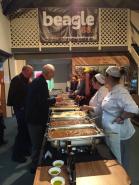
On Wednesday evening, 20th July over 120 people gathered  at 116 Bank St (Company of Giants venue) in Whangarei to celebrate local food and good company.

food banquet speakers banquet Banquet serving

The event was organised by Sean and Rowan Stanley of the Whangarei Food Co-op. The cost of $30/person was an amazing bargain considering the quality (and quantity!) of the food, consisting of a large variety of dishes from Whangarei chefs showcasing our delicious local food!

Rand at banquest Jas at Banquet guitar at banquet serving at banquet sean at banquet Serving 3
During the banquet we heard presentations from growers, chefs, charities and local foodies as well as live music and skits. Clive also presented part of our vision for Local Food Northland.

Food at banquet chefs at banquet clive at banquet

The idea is that this becomes at least an annual (if not seasonal) event.

IMG_1458

(photos by Chris Schreuder, Ian Sturt and Clive McKegg)

The u.Lab free course is highly relevant to local food

Have you done a MOOC yet (Massive Online Open Course)? I have completed Otto Scharmer’s u.Lab course twice now, because it was so good. It is on again in September.

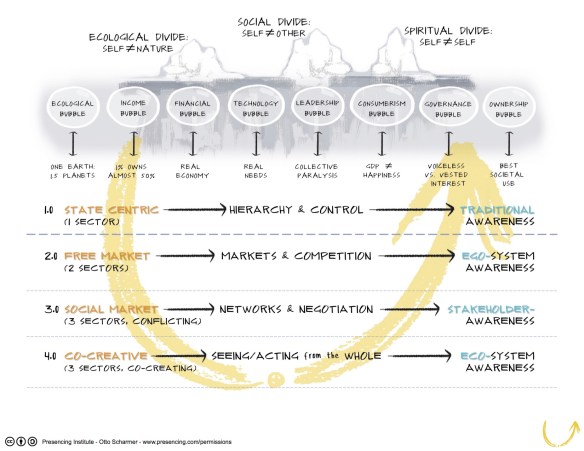
It is highly relevant to our aspirations for local food for at least two key concepts in the course. Otto Scharmer uses hi Theory U to illustrate how our societies and economies around the world have evolved through four stages. The first is state centric, based on hierarchy and centralised control. The next two, free market and social markets, introduced markets and competition and then moderating influences such as NGOs and unions. These three sectors continue to operate in conflict and have exhausted the extent of their value. Proponents of each suggest that more of their chosen ideology will provide the necessary remedy.

U.Lab_Week1_01

Otto Scharmer points to the emergence of a new societal model  – the co-creative society. It is the earlier three sectors, but rather than competing, they are working together – seeing and acting from the whole. In the local food context, we would not have monopolies dominating. The links between food production, consumption, health and a thriving local economy, that are so evident to us, will drive decision making when we get to look at things more holistically.

The second very relevant concept is about our listening. Otto Scharmer guides us through the need to suspend the voices of judgement, cynicism and fear to help us get to a space when we can co-create and together “step into the future that wants to emerge”.

Last year a group of Northlanders get together for weekly “coaching circles” as part of this course. If a group of us were to do the course we could create a coaching circle specifically focussing on local food. Please comment if you are interested.

Here is a link to a short self-paced introductory course and to details of the full course.


What do food policy councils do?

Local Food Northland is exploring how a food policy council might work for Northland. In 2015, there were 282 food policy councils in the U.S. and Canada. We anticipate that a food policy council will complement the grass roots initiatives supporting the shift to sustainable food systems.

So what do food policy councils do? The  Center for a Livable Future Food Policy Network project, run out of John Hopkins university monitor the performance of food policy councils through an annual survey.

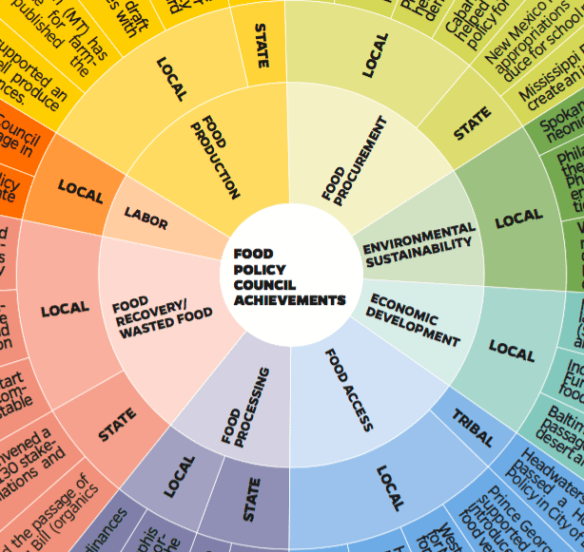
The image below reveals the range of achievements by food policy councils.

Food Policy Council activity.png

Activities include:

  • Food production including action plans, input into legislation and the retention of farm land.
  • Food procurement  with most of the activity focusing on measures to ensure increasing proportions of food for schools is healthy and locally sourced. An important initiative was promoting legislation to give preference to locally grown, processed and prepared foods. This is relevant to Northland where our DHB resisted Ministry of Health policy to have packaged meals delivered from out of region kitchens.
  • Environmental sustainability including bans on bee killing neonicotinoids, zero waste initiatives and purchasing policy supporting recycled, reusable or compostable packaging.
  • Economic development including financial incentives for local food initiatives and the provision of tax credits to support grocery stores in “food desert”locations.
  • Food access initiatives support better health.  Examples are the promotion of healthy mobile food vending legislation, promotion of the North Carolina Healthy Corner Stores Act and funding to support access to healthy food in New Orleans.
  • Food processing initiatives generally focussed on ensuring that legislation didn’t disadvantage smaller producers.
  • Food recovery initiatives support composting, food recovery and better waste reduction practices.
  • Labour initiatives focussed on raising minimum wages.

You can access the report here and its infographic here.

The United States has an advantage that legislation can be passed at local, state and federal government levels. This enables the emergence of innovative policy and regulation that can be observed and replicated by others. This contrasts with our much more centrally controlled system. So for us the solution could include keeping a close eye on international initiatives and establishing a network of food policy councils throughout New Zealand.


A Food Policy Council for Northland?

While current sustainable food system initiatives in Northland are admirable, as yet, they remain relatively poorly connected. If this were to continue, such initiatives will remain as a counter-culture in the prevailing industrial food system. Local Food Northland believe that developing a Northland food policy council, founded democratically as a “grass-roots” initiative with the task of preparing a regional food plan and fostering greater connectivity is a desirable step toward a more sustainable food system.

Here is  an extract about food policy councils from our current research.

It is not surprising that we find strong momentum towards establishing sustainable food systems in the nation that has been at the forefront of the proliferation of fast food chains, food processing and long food chains. In 2015, The United States had 215 Food Policy Councils, with a total of 282 in North America.

Screen Shot 2016-08-20 at 11.15.43 AM

Food Policy Councils in North America

This graph (from John Hopkins Center for a Livable Future) reveals dramatic growth in Councils from 2000 to 2015. Growth appears to have plateaued, but based on its proliferation in North America is primed to expand in other locations world-wide.

Seventy eight percent of these councils are either independent grass-roots organisations or NGOs with Twenty one percent embedded in government or government funded organisations (Center for a Livable Future, 2015).

The Center for a Livable Future’s mission is “to promote research and to develop and communicate information about the complex interrelationships among diet, food production, environment, and human health” (Center for a Livable Future, 2016). The top priorities for Food Policy Councils are healthy food access, urban agriculture/food production, education, purchasing and procurements, networking and food hubs. Other interests are anti-hunger, food waste and fitness(Center for a Livable Future, 2015).

Two examples of Food Policy Councils follow – the first metropolitan and the second regional.

The Toronto Food Policy Council (TFPC)

The Toronto Food Policy Council, established in 1991 is one of the oldest. The TFPC “connects diverse people from the food, farming and community sector to develop innovative policies and projects that support a health-focused food system, and provides a forum for action across the food system” (Toronto Food Policy Council, 2016).

Key documents include the Toronto Food Charter and Cultivating Food Connections, Toronto Food Strategy. The TFPC also collaborates with other organisations in Ontario to promote policy and legislation to shape a sustainable food system. Wayne Roberts (2014) uses a flywheel as a metaphor for food policy councils. They institutionalise and foster innovation providing momentum, rather than having new projects have to start unaided and poorly connected to the diversity in the food system.

Puget Sound Regional Food Policy Council (PSRFPC)

The PSRFPC is much younger, established in 2010. Its vision is a “thriving, inclusive and just local and regional food system that enhances the health of: people, diverse communities, economies, and environments”(Puget Sound Regional Food Policy Council, 2011). In addition to policy work, the PSRFPC has worked on farmers market viability.

Local food and climate change

We have to change our narrative around climate change. Our government tells us that we are too small here in New Zealand to make any positive impact on climate change. But we have been leaders in social change. We were the first nation to give women the vote in 1893, we have been world leaders in social policy and were the first in the Western alliance to take significant action against nuclear proliferation. We can lead with climate change do – or at least do our bit to help.

Growing the local food system generates multiple benefits for the community. As we strengthen the system, we anticipate benefits for health and local economies. Into this mix we can create further synergies by including strategies for climate change mitigation.

A recent NZ Herald article by Victoria Ransom and Phillip Mills highlight the benefits of carbon sequestration in trees and soil. If we were to plant 187 million permanent native trees by 2030, we could return to 1990 emission levels. That’s 40 trees for every New Zealander or 6.3 million trees in Northland. And we can anticipate that displacing oil with renewables will enhance these gains.

Ministry of Agriculture and Fisheries data reports sequestration rates ranging from 7tonnes of CO2/ha for unimproved pasture to 1238 tonnes of CO2/ha for lowland podocarp broadleaf forest. Mixed manuka/kanuka scrubland ranges between 238 and 554 tonnes of CO2/ha.

plantings benefits

Imagine if we were to accelerate the rate of plantings around waterways, roadways and city streets. We can create food forests in urban areas and food for bees in rural areas. As our waterways become more protected by a mantle of trees, less sediment and nutrient flows into the water and water quality improves. The network of green corridors enhances birdlife and makes our region even more beautiful. And these efforts sequester carbon hopefully protecting us from the worst impacts of climate change.

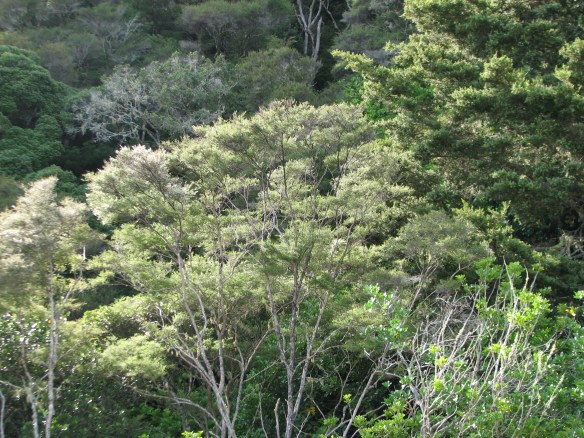
Kanuka is a great option for planting. It grows much bigger than its cousin manuka, reaching up to 18 metres. While not sequestering as much carbon as denser mixed forest, it  sequesters much more than pasture. The honey has qualities as least as good as manuka.

The impacts of climate change are scary and seem to be intensifying more quickly than most of us anticipated. Its time to shake of our inaction knowing that we have options, and individuals can make a difference.

kanuka

Kanuka (Kunzea ericoidies) grows to an impressive size and its early summer floral displays are under-rated.

Sustainable food systems and the UNEP

Take a look at this brilliant video from the United Nations Environmental Programme (UNEP). In under 4 minutes it provides a clear and concise evaluation of our global food system.

It is good to know that at the highest level of global governance there is awareness of the dire state of our food system. The video briefly explores solutions, notably the need to break down the silos between government and health authorities, producers, consumers and business people.

Simply identifying the food system as a system is a great start. When we are embedded in systems, often systems that we were born into, we tend to take the status quo for granted. For example my parents shopped at local grocery stores whereas I now shop at supermarkets. My children’s first experience of supermarkets were as infants – they have grown up with the phenomena.

So how do we effect change? This will be explored in future posts.

You can check out the UNEP Sustainable Food Systems Programme here. Their video was uploaded to YouTube on May 9 2016 and in 10 weeks has only had 4049 views. Please share this post or the video URL to increase circulation of these ideas.

Please also feel free to comment? How do you think we can effect change?

The iPES-Food report – from uniformity to diversity

In June 2016 the International Panel of Experts on Sustainable Food Systems released its first thematic report, From Uniformity to Diversity: A paradigm shift from industrial agriculture to diversified agroecological systems. The report advocates the shift from industrial food systems to sustainable food systems.

The failure of the industrial food system is presented starkly in the figure below, from page 9 of the report.

iPES Food industrial food systems failure

Failures of the industrial food system.

In 2015 4.7 billion suffered from inadequate nutrition, that is 6 out of every 10 people. While other global systems are complicit in this failure, collectively we have failed, given the technology we have, the education systems and the exploitation of cheap energy sources.

The report states:

Today’s food and farming systems have succeeded in supplying large volumes of foods to global markets, but are generating negative outcomes on multiple fronts: wide- spread degradation of land, water and ecosystems; high GHG emissions; biodiversity losses; persistent hunger and micro-nutrient deficiencies alongside the rapid rise of obesity and diet-related diseases; and livelihood stresses for farmers around the world.

As someone working at the local level towards sustainable food systems, it is heartening to know that at the global level awareness of the failure of orthodox systems are rising, and there are organisations uniting people from diverse nations to take action. The transformation of our food systems is a place where we can think globally and act locally. Of all of the critical systems that support our economic and social well-being, food is a catalyst for change.

The report includes excellent analysis of the eight “lock-ins” that perpetuate the industrial food system. We can erode their influence with the opportunities emerging around the planet.

  1. Policy incentives for diversication and agroecology
  2. Building joined-up ‘food policies’
  3. Integrated landscape thinking
  4. Agroecology on the global governance agenda
  5. Integrated food systems science and education
  6. Peer-to-peer action research
  7. Sustainable and Healthy Sourcing
  8. Short supply chains .

I commend the work of the iPES-FOOD panel. Enjoy their report.


Food chains or food webs?

The choice is becoming starker as we learn more about the impacts of industrial food delivered through long food chains. Do we want to support industrial food delivered through long food chains or sustainable food systems closer to home? This is the first of a series of extracts from Our Food Story. But first, here is Pete Russell personalising the shift from a long food chain to a food web advocate.

Food chains are the food system manifestation of supply chains. Globalised food chains are long food chains (LFC), while localised food chains are short food chains (SFC).

Short food chains

SFCs generate closer relationships between producers and consumers enabling the re-socialising of food. SFC offer consumers food with known provenance and enhanced quality. Critically, SFCs open opportunities for revitalising rural communities (Marsden, Banks, & Bristow, 2000). Face to face interactions between producers and consumers collapse the power-differences inherent in complex, globalising LFCs. (Feagan, 2007). Continue reading

Our food story

Our Food Story

Today Our Food Story, an investigation into Northland’s food system is being published. It surfaces a compelling vision of the benefits accruing from a more connected and local food system. The executive summary from the document is reproduced below.

Thank you to my co-researcher Eloise Neeley for her superb work over summer to enable this report to happen.

Executive summary

We all eat it, and food has been fundamental to our economies for millennia. This report reveals opportunities to reshape our local food system with strong economic and social benefits. It is difficult to think of another industry as pervasive as the food industry. On the production side, it provides an economic base across our region, rather than being concentrated in Whangarei and Northland’s towns. On the consumption side it feeds whanau, but also patients in health facilities and customers in cafes, restaurants and hotels.

We are currently far from optimising the potential of the food system. Food distribution is dominated by corporations who primarily operate here to extract dividends for their shareholders, rather than support a “sticky economy”. Fast Food chains (also here to extract dividends) and supermarkets sell food that is often nutritionally deficient generating a plethora of diet based disease. The average weekly spend of New Zealand households is $61.90 on alcoholic beverages, tobacco and ready to eat foods, but only $22.60 on fruit and vegetables. Shifting this equation even minimally will have positive impacts.

This report focuses on food produced for local consumption. It integrates data from desktop research and interviews of 32 people involved in food production, consumption and outlets. It reveals opportunities to improve returns to growers while creating a stronger value proposition for food outlets. There are also exciting opportunities for added value processing. Data from two U.S. locations identify actual and potential new jobs generated by a re-invigorated local food system equating to between 233 and 477 jobs for Northland. The economic benefit of substituting 20% of produce imported into the region with local food sold through local food distributors and outlets, this would equate to additional economic benefits of $27.7 to $55.4 million annually for Northland.

The synergies between employment and enterprise generation, social cohesion and the potential to revolutionise positive health outcomes remain largely unexplored in Northland centres. We offer this report as a platform to generate momentum towards a more robust food system.

Our recommendations are:

  1. Investigate the feasibility of food hubs in Whangarei and other Northland Centres.
  2. Convene a regional discussion on the local food economy.
  3. Promote local food.

You can access a copy of the report here. Our Food Story: Understanding the market dynamics of fruit and vegetable production, distribution and produce outlets in Northland