EVs for the Whangarei District Council!


Update: The Whangarei District Council passed the remits! Its good to live in a city with visionary governance 🙂


Councillor Stuart Bell has tabled a supplementary agenda item for the Council’s meeting on Thursday 30th March – this Thursday!

2. Proposed motion

  1. That Council, before 30 June 2017, adopt an ‘electric first’ vehicle policy to transition our vehicle fleet to full battery and plug-in-hybrid electric vehicles as the current fuel powered vehicles are due for replacement.
  2. That Council applies to the Low Emission Vehicles Contestable Fund to assist with the development of infrastructure within the Whangarei District to encourage, accelerate and support the uptake of electric vehicles by businesses and private individuals.
This is a real opportunity for our District Council to go electric! Please urge your ward councillors to vote in favour (contact details here).
Please encourage your Councillor to support this motion. Think also about asking your employer to make a similar move. If you want more information about fleet purchases, Joe Camuso at the Northland Regional Council will be able to help.
The-EV-Highway-Northlands-EV-Expansion-PIC-4-caption-Joe-Camuso-Northland-Regional-Council

Joe Camuso is a strong advocate for evs and has recently secured further additions to the Regional Council’s fleet. 

Range anxiety

The most popular option for Whangarei ev drivers has been the Nissan Leaf. With newer Leafs (Leaves?) featuring a 30 kw battery, range has now increased to about 170 km – more than enough for most of our daily commutes.


Archeological evidence of pre-European gardens at Whangarei

Heritage New Zealand is hosting “a short archeological walk” that reveals evidence of both pre European gardens and early European settlement. Meet at the riverside of Hatea Drive opposite the Settlers Hotel at 12 noon on Saturday 8 April. Go to their website for more details.

Food evolution and health in Aotearoa

Our focus at Local Food Northland is about the shift from industrial food systems to sustainable food systems. For us to better understand our current food system reality, we look back to look forward. This is the first of three posts to explore the tides of history that have shaped our food system.

Two hundred years ago was mostly populated by Māori and they ate mostly fresh food – some was dried for preservation or perhaps fermented. Over the last two centuries our dietary patterns have changed dramatically. In conjunction with changes in health care we have longer life spans, but the consequence of our twenty first century diet is an alarming increase in diet-related disease. As my colleague at NorthTec, Nigel Studdart writes:

We are what we eat and what we are becoming is an increasingly overweight and unhealthy population.

There are three major drivers of dietary change in Aotearoa, the impacts of colonisation, industrialisation and consumerism.

food evolution aotearoa

Colonisation

Before the arrival of Europeans, Māori were isolated in Aotearoa and there was therefore no imported food. Neither was food processed beyond cooking, drying or fermenting.

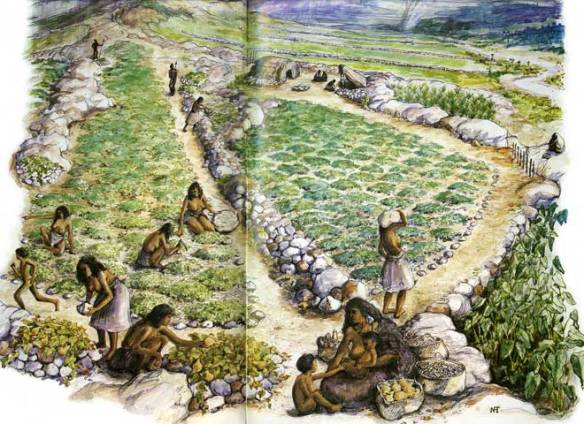
1700s garden

This image from Te Ara is an artist’s impression of a 1700s garden in the Auckland region (drawing by Nancy Tichborne). 

Gardens were community enterprises with crops grown including taro, hue (gourds) and kumara. Helen Leach’s book 1,000 Years of Gardening in New Zealand documents pre-colonial gardening. It includes a drawing by one of Captain Cook’s crew of an East Coast garden with kumara, yam, taro and gourd.

According to Te Ara (The Encyclopaedia of New Zealand) Māori had a life expectancy of about 30. This is low, but better than that of Britain at the time. But “by 1891 the estimated life expectancy of Māori men was 25 and that of women was just 23 (Te Ara). We cannot attribute this to diet, as disease, alienation from land, war, and war’s inevitable consequence, poverty, saw population decline and life expectancy reduce.

Māori adapted quickly to the new foods bought by Europeans, soon producing large quantities of food including potatoes, fruit and meat. By the mid 1800s, Māori were producing flour in their own mills from their own wheat.

Imported foods began to supplement local diets and the appetite for sugar was such that the Chelsea Sugar Refinery was established in 1883. Sugar is increasingly associated with the incidence of non-communicable disease (NCDs). In a food environment where Māori were struggling with the aftermath of war, European diseases, land alienation and the impact of tobacco and alcohol, sugar became another health burden. The world view of the colonialists was shaped in part by social Darwinism and assumption of the innate superiority of Europeans, especially English. In this context, Dr Isaac Featherson said it was the duty of Europeans to “smooth down … [the] dying pillow’ of the Māori race.” Thus the food landscape for Māori in the second half of the nineteenth century was not conducive to health.

The communal approach to gardening was probably one factor that enabled Māori to sustain and recover the population.

Maori population graph

This graph (from Te Ara) shows Māori population from 1841 to 2006.The decline post-Treaty took almost a century to recover. Arguably, the homogenising of assumptions of colonisation continued largely uncontested and dissenting voices unheard through the middle decades of the twentieth century.  The Māori renaissance of the late twentieth century laid the foundation for reshaping the food environment, but the forces of industrialisation and consumerism invoked another form of colonisation that dominated the food landscape as we shall see in the next two posts on this topic.


Is the food policy pasture greener in New Zealand?

Anne_Palmer-reducedBy Anne Palmer

Program Director
Food Communities & Public Health Program
Center for a Livable Future
Johns Hopkins University

Anne was a keynote speaker for the Local Food Northland Conference in February this year. In this post she reflects on her time in New Zealand. See the original post here.


A failing dairy industry. Streams polluted by animal manure. Consolidated food retail, inadequate slaughter facilities for small – and medium-size producers, the list goes on. Where am I? New Zealand. Yep. Before I stepped foot on the soil, I was cautioned that I should not believe the “cleaner, greener” moniker. I’m not sure if it was heartening to blow up the myth and realize we are all suffering from industrialization of the food system, or just depressing that problems in the food system are dispersed so far and wide.
The solutions are dispersed, too. Back in September, Peter Bruce-Iri from Local Food Northland invited me to New Zealand to keynote and participate in a two-day food conference. He had studied the food council model and wanted to introduce it as part of a larger strategy for rebuilding the Northland’s regional food system. It took me about 30 seconds to make my decision (even with my carbon footprint in mind). How could I say no to New Zealand? Peter suggested additional connections for me to make my trip even more meaningful, including a webinar for the Good Food Network organized by Emily Dowding-Smith from the Sustainable Business Network and a workshop with Healthy Families Rotorua, arranged by Jasmin Jackson.The original plan was to hold an advance food-foraging event that would provide food for the conference. (I imagined myself in an Omnivore’s Dilemma scenario, but the wild boar would remind me of Wilbur in Charlotte’s Web). That plan was thwarted by regulations that prohibit the sale of food that has been “caught wild.” Nevertheless, thanks to Ian and his sous chefs, I gained three pounds in eight days. And every pound was worth it. Even though we were unable to forage for our meals, most of the delicious food was sourced locally.

I spent my Saturday morning at the Whangarei Growers Market with Jeff Griggs, a co-founder of the Local Food Northland endeavor. Jeff is an American who immigrated to New Zealand many years ago and now farms avocados and cut flowers, along with other produce like kiwifruit outside of town with his dog, Ted. The oldest growers market in New Zealand, Whangarei Growers Market regulates that you can only sell what you grow, and Robert, the market manager and 70-year-old farmer, explained he has no problem tracking down the offenders because the produce looks different. I watched him collect the $20 stall fee from vendors while we shopped for Luisa plums, blueberries and lavender products. (Note to self: organize trips based on seasonal harvesting schedules).

After the market, Jeff invited me to join the weekly Whangarei Transition Town meeting at the local library where residents discuss ways they can improve self-sufficiency at the local level. Originating in the UK in 2006, the Transition Towns movement seeks to address peak oil and climate change, and challenge the notion of unlimited economic growth. We had a lively discussion about school gardens, people’s eating habits, electric cars (thanks, Ross) and more.

handsome frog

And now on to the conference. Close to 100 people gathered at the marae (including students from North-Tec, growers, public health professionals, chefs and researchers) for the powhiri, a traditional Maori welcome. Whangarei’s mayor, Sheryl Mai, also welcomed us in Maori. Participants lined up to touch foreheads and noses with the planning committee, a Maori greeting called hongi, which symbolizes sharing the breath of life. As a lifelong hugger, this was a reverent experience.I talked about the various food movements in the U.S. with a special focus on what is happening around food policy councils, why policy is important and how the various food movements are working together to activate change. (One participant told me he never thought policy was important until he heard me. Best compliment ever.)

Over the two days, we heard from Peter about the features of a sustainable food system and importance of scale-appropriate policy. Ruth Marsh introduced the Vermont Farm to Plate framework, which Local Food Northland has been using to guide their regional effort. Rangimarie Price talked about how Maori principles on sustainability are embedded in the local food strategy. Jeff discussed how to connect and build a network for collaborating. There was a lively discussion about the role of chefs and restaurants in supporting local producers. While some of the larger cities have capitalized on the farm-to-table concept, in smaller cities like Whangarei, chefs are sourcing from local growers with very little or no marketing efforts.

I joined the policy discussion for the small group breakout and heard Regina, a NorthTec student and single mom who is working with faculty on various food endeavors, bemoan the demise of her kitchen garden this year because she is going to school full-time and raising her four children. I have heard this same conundrum in many focus groups and community meetings in Baltimore; doing the “right thing” frequently falls on the backs of those who have the least amount of time.

On Day Two, we heard from renowned nutrition scientist Barbara Burlingame about sustainable diets and nutritional superiority of native bananas versus the Cavendish variety that is ubiquitous in supermarkets around the world. Northland has a variety that reminds me of passionfruit, and there are discussions about reviving that industry. (Lucky for Northland, Barbara just moved back to Wellington and joined the faculty at Massey University after 16 years at FAO in Rome as the deputy director of the nutrition section). Dr. Melissa Gilbert, an integrative medicine doctor, discussed her efforts to get patients to grow and eat from backyards. Dr. Laupepa Va’a from the district health board talked about food recovery efforts in Northland. A diverse panel of growers debated the challenges they face from a policy and climate perspective, while another panel focused on the role of food hubs in rebuilding distribution systems. Clive McKegg, the third leg of the Local Food Northland founding members (along with Peter and Jeff), wrapped up the conference by discussing how the Local Food Northland’s mission “to establish Northland as a centre for growing and processing tasty healthy foods in ways that build community cohesion, increased economic resilience, improve health outcomes and enhance the natural environment” can be actualized in their collective efforts. I left inspired and remain inspired as I witness the conference follow-up on the Loomio online platform, designed by a New Zealand company.

After my time in Whangarei, I traveled to Rotorua, which was challenging. I liken this part of the journey to the 80s classic movie, Planes, Trains and Automobiles (think Buses, Cars and Hitchhiking). Lucky for me, Hayley, another conference attendee, was scheduled on my flight and she took the reins to get me to my destination that day. I strolled around Rotorua’s thermal lake, careful not to step in a bubbling hole, and enjoyed the hotel’s thermal pools while preparing for the second workshop.

Jasmin Jackson from Healthy Families Rotorua invited me to meet with groups from Rotorua and Tauranga who have been engaged in food and nutrition activities in their area and want to expand to policy. About 45 people attended the workshop, many from the public health sector. Healthy Families, working in 10 locations across New Zealand, is a national initiative that seeks to create health-promoting environments in the community and is involved with food policy efforts in other parts of the country. We talked about the opportunities and challenges associated with local food policy and ideas for strengthening their network. Even with the central government driving most legislation, I learned that New Zealand’s regional government structure offers options for organizing, especially around regulations for small-scale growers, land use, distribution networks and public health. I heard several participants talk about the importance of policy being informed by research, opportunity to expand public health mapping to other food system components and the need to better understand existing supply chains to improve distribution.

I travelled 23 hours to find myself in a beautiful location (since this is a food policy blog, I did not talk about the beautiful beaches, frolicking dolphins or the rails-to-trails bike ride, but those were also remarkable) that is facing many of the same issues we have in the U.S., albeit at a different scale. It is a scale that may serve them well as I witness the conversations among the conference participants already deciding how to move forward. I invite them to share their challenges and successes with us here in Crazy Town, where microwaves spy on you.

Blessed are the cheese-makers

At the recent New Zealand Champions of Cheese Awards, two Northland companies came out on top. Cathy Oakley of Winsam Farm near Kerikeri and her husband was named the Champion Cheesemaker for her sheep milk cheese. It was her first year in the competition. You can read more about her here.

grinning gecko

Grinning Gecko’s brie was named the nation’s best soft white rind cheese, and Zev Kaka-Holtz was named the best aspiring cheesemaker. His is a story that celebrates local enterprise. You can see his story in a short Seven Sharp feature.

Other awards were won by Mahoe Farmhouse Cheese and George’s Cheeses from Kerikeri.


Localising food, climate change and the implications for food security in eastern Northland

By John Clarke
The 2016 Climate Change Projections for NZ  predict that the eastern half of Northland will experience hotter, drier summers with less winter rain and frosts. Droughts will become more common, as will extreme weather events. Relative humidity will decrease and evapotranspiration will increase. I believe that planning our landscapes to meet these changes will increase our chances of successfully localising our food supply.
Recently there has been interest in developing a tropical fruit industry in Northland. I suggest that by adopting mixed plantings of alley crops on contour with appropriate soil building techniques (such as the Yeoman’s plough on contour), water harvesting techniques (such as swales and vetiver grass), and minimisation of soil cultivation through direct reseeding, I believe that we can reduce risks while maximising production, minimising input costs, maximising soil water absorption, minimising evapotranspiration, and reduce stress on aquifers (from pollution and overuse).
For instance, monoculture banana plantations are decimated by extreme weather events. The world’s main banana crop, the Cavendish, is under threat from the Panama disease fungus which already exists in Australia and there is no known treatment. Therefore, developing a banana monoculture industry would seem high risk. An alternative would be to form landscapes that maximise water collection at swales and on-farm dams (whenever we resort to aquifers for irrigating, we engage in an ultimately unsustainable agriculture). Landscape resilience could be increased by alley cropping a mixture of bananas on contour with an Alan Savory style livestock grazing system and further refine that with multi-species grazing. This would build soil organic matter rapidly and even more so with annual use of a Yeoman’s plough. Nutrient, microbe and water holding capacity of the soil could be enhanced by the addition of biochar and avoidance of soil cultivation.
To increase the protection of the banana crops to strong winds and evapotranspiration, alternate alleys could be planted with trees crops, and banana alleys could be interspersed with nitrogen fixing trees such as honey locust. The bananas (which would ideally be planted in the damper ground below swales) could be planted with taro, and probably within 5 years, with ginger and turmeric.
A mixed cropping landscape would increase food security by better enabling a yield in years of extreme weather.
The photograph of Mike Shepherd’s New Forest Farm below, is an example of the way a farm can be designed to withstand climate change and extreme weather while providing a wide range of yields.
newforestfarm

The nutritional value of local bananas

Professor Barbara Burlingame provided a compelling case study about the nutrient content of local bananas at our February conference. Before returning to New Zealand she spent 16 years with the UN’s Food and Agriculture Organisation including the last four as Deputy Director of the Nutrition Division as was closely involved with the research referred to here.

Professor Burlingame related the story of Pohnpei, a Micronesian Island north of the equator. Over time the people their drifted away from their indigenous diet to consuming increasing quantities of imported food. There were consequences.

The change in food habits from fresh traditional foods to processed imported foods has been accompanied by high prevalence of overweight, obesity, diabetes, heart disease and cancer among the adult population, while micronutrient deficiencies, such as of vitamin A, are prevalent among children[1].

Well intentioned interventions

Starting in the 1960s, the United States Department of Agriculture (USDA) initiated supplementary feeding programmes to Pohnpei, using surplus commodities such as rice and tinned foods. These food aid programmes, including a school lunch programme, “introduced rice and processed foods to many children and adults in Pohnpei, establishing new food habits, attitudes and food tastes that persist today”[2].

In a story similar to that of other indigenous communities transitioning from the food systems they controlled to Western diets, the unintended consequences, especially the vitamin A deficiency, sparked further inteventions. Vitamin A supplements, including injections, were provided for children.

Karat banana

The Karat banana, often the first sold food for Pohnpei’s babies. (Photo from Web Ecoist)

Researchers, led by the late Dr Lois Englberger, turned their attention to local foods. Pohnpei has 26 banana cultivars. One of these, Karat, has deep yellow/orange flesh indicating the presence of provitamin A carotenoids.

When analysed for its nutrient profile, the Karat cultivar provided up to 2230 units of carotenes. Another cultivar, Utin Lap has up to 8508 units of carotenes. By contrast, Cavendish, the variety found in supermarkets around the world has less than five units of carotenes. The answer to the debilitating vitamin A deficiency was close by all that time. Consequently the government of the Federated States of Micronesia championed the local food movement and when Dr Englberger died in 2011, they held a memorial service in her honour.

Nutrition of Northland bananas

The health of our food can be evaluated by the nutrients it provides and the impact of artificial chemicals used in its growing, processing, transportation and storage and impacted by the way we cook it.

This website provides detailed coverage of bananas’ food value.

Fruits and vegetables with orange or red flesh are rich in carotenes, so we can anticipate that our locally grown bananas will be closer to the levels found in Cavendish bananas. However, it will be interesting to have the analysis done. Perhaps we could crowdsource funding for this to support the development of the local banana industry.


[1] Let’s go local! Pohnpei promotes local food production and nutrition for health in Indigenous people’s food systems & well-being (2013) Food and Agriculture Organization of the United Nations, page 195). http://www.fao.org/docrep/018/i3144e/i3144e00.htm

[2] ibid, page 194


Banana maths – a Northland banana industry?

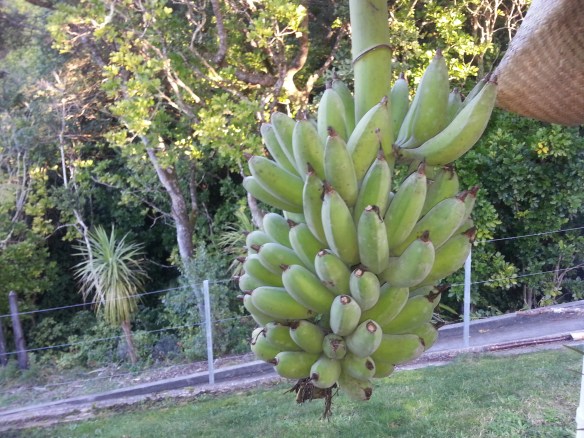
What would a Northland Banana Industry be worth to the local economy? Bananas are starting to appear regularly at the Whangarei Growers Market.

Consumption per person per year (kgs)[1] 18
Northland population[2] 171,400
Total banana consumption (kgs) 3,085,200
Price per kilo[3] $2.99
Total cost of bananas consumed in Northland $9,244,748

There are many variables to consider to refine these numbers, but they act as a reference point.

Bananas at home

Earlier studies reveal that produce grown locally rather than imported into the region (and country in this case) create a 2 to 4 times multiplier in both jobs and dollars. The report, The Social and Economic Impact of the Whangarei Growers Market identified the multiplier at 2.99. This work was done by economist Dr Warren Hughes.

So let’s be conservative and aim to supply 10% of Northland’s bananas, 300,000 kgs or 300 tonnes by 2025. The nearby Auckland market could probably take all we could produce.

Targeted production (kgs) 300,000
Price per kilo $4.00
Total cost of Northland produced bananas $1,200,000
Multiplier 3
Value of the Northland banana industry $3,600,000

Currently, local bananas are selling for more like $8.00 a kilo, but as production increases we can anticipate the price reducing – so these estimates are conservative.

Realising this $3.6 million industry would be challenging. Bananas required frost free locations. They can handle light infrequent frosts and surely we have plenty of microclimates where we could grow them. It would also require a significant number of banana plants to be propagated. Perhaps tissue culture is a solution.

The other requirement would be for roughly 10% of Northlanders to buy Northland bananas exclusively – this is an appealing challenge, because it provides an opportunity to support the local industry and to access a product that is much healthier.


[1] Bananas top the list of Trolley items. (26.02.2017) Kirsty Wynn. NZ Herald. Retrieved http://www.nzherald.co.nz/lifestyle/news/article.cfm?c_id=6&objectid=11805447

[2] Northland Region. Wikipedia https://en.wikipedia.org/wiki/Northland_Region. Population at June 2016

[3] Sourced from Countdown online on 5 March 2017. https://shop.countdown.co.nz/#url=/Shop/SearchProducts%3Fsearch%3Dbanana%2Bfresh