A better environment and sustainable food systems

We waste too much food because it is too cheap according to Jason Clay, the Senior Vice-President for Market Transformation at the World Wildlife Fund. If we were to include the cost of the impact of food production (the externalities) food would cost twice as much. The World Wildlife Fund was established over 50 years ago to protect nature, but faced with the enormity of the task, 20 years ago they determined that food production  was the biggest threat to biodiversity.

“the single largest threat to every place is where and how we produce food”

In his 2010 Ted talk Jason Clay identified that 300 to 500 companies control 70% of the connections between producers and consumers in each commodity. Just 100 companies control 25% of that trade. These companies are typically motivated to optimise their profits and the food supply chains continue to get longer. As value is extracted in the middle of the chain, the rewards for producers diminish. Ironically and tragically, millions of small farmers don’t have enough food.

jason-clay-ted

The bottleneck in food systems (from Jason Clay’s TED talk, 2010)

Jason Clay’s thinking is directly relevant to Northland and our move to more sustainable food systems. We want to see more local producers, less processed food and closer connections between producers and consumers.

The other important work for the World Wildlife Fund is working with inefficient  producers that tend to create more damage environmentally and the failure of governments to enforce regulations – again relevant in Northland.

Jason Clay is in New Zealand now. Listen to Kathryn Ryan’s interview here. Here is his 2010 TED Talk.

Free fish heads

Here is a great example of software facilitating better resource use. The ability of software to facilitate direct connections between producers and consumers are important in developing more sustainable food systems – in this case, reducing food waste.

Free Fish Heads from Tightlines Television on Vimeo.

Here is a link to Free Fish Heads.

Kaiora honey

Manuka honey has enabled the Murray whanau in the Far North to re-establish a strong economic base back on their rohe (tribal lands). The story of Northlanders re-establishing their cultural and economic base on the land is a important and encouraging step in our move towards sustainable food systems.

kaiora-honey

Their story is told in this Country Calendar feature. (Note that the episode is incorrectly labelled on the TVNZ website). You will need to register to watch it.

Tae Murray returned to the north a qualified bee-keeper and his sister Blanche studied business and project  management. The rest of the whanau came back home to join the business. Kaiora Honey is now a thriving business exporting high value honey.

Manuka honey earns a huge premium in the international marketplace based on its health-giving qualities. The sought after healing properties of manuka honey are quantified in the unique manuka factor (UMF) rating indicated by the concentration of leptosperin in the honey.

Manuka and kanuka were once characterised as scrub, to be slashed or burnt to make way for pasture. The honey’s new status as a superfood is changing the dynamic of the landscape throughout New Zealand. People are now doing what was unthinkable a couple of decades ago, and replanting manuka. It is a pioneer plant that rejuvenates the soil and is many times more effective at sequestering carbon than pasture. As manuka and kanuka stands are enhanced, we have the opportunity to enrich ecosystems, protect waterways, and rejuvenate communities and local economies.

Here is Dr Josh Axe outlining the benefits of manuka honey.

And here is the article he refers to about the benefits of manuka honey. They include:

  1. reducing reflux and balancing the digestive system
  2. treating acne and eczema
  3. treating staph infections
  4. healing burns, wounds and ulcers
  5. healing tooth decay and gingivitis
  6. relieving inflammatory bowel disease
  7. boosting immunity
  8. relieving allergies and sinusitis
  9. improving skin tone and texture
  10. improving sleep.

Co-operatives

Ken Ross returned recently from Italy excited about their co-operatives. The Emilia Romagna region is one of the most prosperous in Europe and the home of luxury car manufacturers, Ferrari, Lamborghini, Maserati and Ducati. It has a population of 4.5 million with two out of every three citizens in co-operatives. This Prezi has more background.

emilia-romagna

This map of Emilia Romagna shows the range of produce common in the region. Click here for a larger image.

The roots of the co-operative movement in Italy were in the nineteenth century. Visionaries promoted collective economic enterprises, not based on individualism and self-interest. In this interview, Italian academic Vera Zamagni also identifies socialist and Catholic foundations for the movement. More recently, Article 45 of the Italian Constitution, lays a solid policy foundation for co-operatives, for example, one person, one vote.

Vera Zamagni identifies four types of co-operatives.

  1. User co-ops – for collective access of goods and services.
  2. Producer co-ops –  such as farmer co-ops.
  3. Social co-ops – delivering personal services such as health services.
  4. Worker co-ops – where workers supply capital and participate directly in management.

New Zealand agriculture has a strong co-operative tradition, but without the constitutional protection of “one person, one vote” these typically evolve to control by a managerialism with a consequent alienation of members. Faggiola is one example of co-operative food production in Northern Italy.

“…cooperatives tend to humanize the market because of their rules of functioning: the person – the member – is at the centre, not capital”. (Vera Zamagni)

Fruit and nuts unlimited

Earthcare Education Aotearoa are finding inspirational stories about local food across Aotearoa (New Zealand). Their latest video explores plantings of fruit and nut trees in public spaces from 50 locations around the country. This video introduces the project.

Fruit & Nuts UNLIMITED! – TRAILER from The Localising Food Project on Vimeo.

Here is a link to their Pledge Me site to fund the project.


Kaicycle- food waste recycling

Wellington’s Kaicycle is supporting the shift to sustainable food systems with urban food waste recycling. They use bikes to collect organic waste from homes and businesses, compost it, and use that compost to grow food. Half of that food is given away to organisations such as Kaibosh.

It is inspiring to see sustainability embedded in their business model. Their bikes make their operation carbon neutral, they reduce organic waste going to landfills, and grow food to provide better access for those in need.

Here is a Radio New Zealand interview about Kaicycle.


The Gocks save the kumara

Here is a short video from Loading Docs featuring the Gocks and their story as refugees. When kumaras in the Northern Wairoa were afflicted with black rot, Joe and Fay Gock provided new disease free kumara from their Mangere farm.

http://loadingdocs.net/mrandmrsgock/

https://vimeo.com/176540653

Hear more about them from this Radio New Zealand podcast. This is a timely story about the positive influence of refugees in the country that gave them a fresh start.

The u.Lab free course is highly relevant to local food

Have you done a MOOC yet (Massive Online Open Course)? I have completed Otto Scharmer’s u.Lab course twice now, because it was so good. It is on again in September.

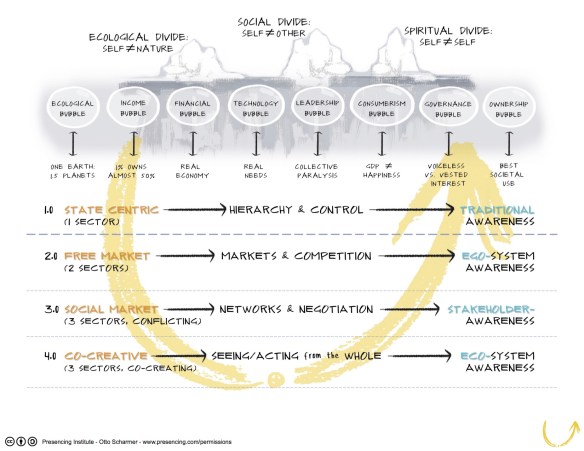
It is highly relevant to our aspirations for local food for at least two key concepts in the course. Otto Scharmer uses hi Theory U to illustrate how our societies and economies around the world have evolved through four stages. The first is state centric, based on hierarchy and centralised control. The next two, free market and social markets, introduced markets and competition and then moderating influences such as NGOs and unions. These three sectors continue to operate in conflict and have exhausted the extent of their value. Proponents of each suggest that more of their chosen ideology will provide the necessary remedy.

U.Lab_Week1_01

Otto Scharmer points to the emergence of a new societal model  – the co-creative society. It is the earlier three sectors, but rather than competing, they are working together – seeing and acting from the whole. In the local food context, we would not have monopolies dominating. The links between food production, consumption, health and a thriving local economy, that are so evident to us, will drive decision making when we get to look at things more holistically.

The second very relevant concept is about our listening. Otto Scharmer guides us through the need to suspend the voices of judgement, cynicism and fear to help us get to a space when we can co-create and together “step into the future that wants to emerge”.

Last year a group of Northlanders get together for weekly “coaching circles” as part of this course. If a group of us were to do the course we could create a coaching circle specifically focussing on local food. Please comment if you are interested.

Here is a link to a short self-paced introductory course and to details of the full course.


What do food policy councils do?

Local Food Northland is exploring how a food policy council might work for Northland. In 2015, there were 282 food policy councils in the U.S. and Canada. We anticipate that a food policy council will complement the grass roots initiatives supporting the shift to sustainable food systems.

So what do food policy councils do? The  Center for a Livable Future Food Policy Network project, run out of John Hopkins university monitor the performance of food policy councils through an annual survey.

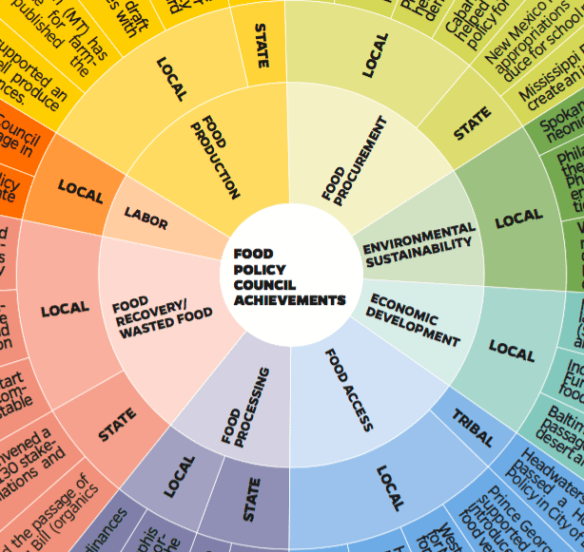
The image below reveals the range of achievements by food policy councils.

Food Policy Council activity.png

Activities include:

  • Food production including action plans, input into legislation and the retention of farm land.
  • Food procurement  with most of the activity focusing on measures to ensure increasing proportions of food for schools is healthy and locally sourced. An important initiative was promoting legislation to give preference to locally grown, processed and prepared foods. This is relevant to Northland where our DHB resisted Ministry of Health policy to have packaged meals delivered from out of region kitchens.
  • Environmental sustainability including bans on bee killing neonicotinoids, zero waste initiatives and purchasing policy supporting recycled, reusable or compostable packaging.
  • Economic development including financial incentives for local food initiatives and the provision of tax credits to support grocery stores in “food desert”locations.
  • Food access initiatives support better health.  Examples are the promotion of healthy mobile food vending legislation, promotion of the North Carolina Healthy Corner Stores Act and funding to support access to healthy food in New Orleans.
  • Food processing initiatives generally focussed on ensuring that legislation didn’t disadvantage smaller producers.
  • Food recovery initiatives support composting, food recovery and better waste reduction practices.
  • Labour initiatives focussed on raising minimum wages.

You can access the report here and its infographic here.

The United States has an advantage that legislation can be passed at local, state and federal government levels. This enables the emergence of innovative policy and regulation that can be observed and replicated by others. This contrasts with our much more centrally controlled system. So for us the solution could include keeping a close eye on international initiatives and establishing a network of food policy councils throughout New Zealand.


A Food Policy Council for Northland?

While current sustainable food system initiatives in Northland are admirable, as yet, they remain relatively poorly connected. If this were to continue, such initiatives will remain as a counter-culture in the prevailing industrial food system. Local Food Northland believe that developing a Northland food policy council, founded democratically as a “grass-roots” initiative with the task of preparing a regional food plan and fostering greater connectivity is a desirable step toward a more sustainable food system.

Here is  an extract about food policy councils from our current research.

It is not surprising that we find strong momentum towards establishing sustainable food systems in the nation that has been at the forefront of the proliferation of fast food chains, food processing and long food chains. In 2015, The United States had 215 Food Policy Councils, with a total of 282 in North America.

Screen Shot 2016-08-20 at 11.15.43 AM

Food Policy Councils in North America

This graph (from John Hopkins Center for a Livable Future) reveals dramatic growth in Councils from 2000 to 2015. Growth appears to have plateaued, but based on its proliferation in North America is primed to expand in other locations world-wide.

Seventy eight percent of these councils are either independent grass-roots organisations or NGOs with Twenty one percent embedded in government or government funded organisations (Center for a Livable Future, 2015).

The Center for a Livable Future’s mission is “to promote research and to develop and communicate information about the complex interrelationships among diet, food production, environment, and human health” (Center for a Livable Future, 2016). The top priorities for Food Policy Councils are healthy food access, urban agriculture/food production, education, purchasing and procurements, networking and food hubs. Other interests are anti-hunger, food waste and fitness(Center for a Livable Future, 2015).

Two examples of Food Policy Councils follow – the first metropolitan and the second regional.

The Toronto Food Policy Council (TFPC)

The Toronto Food Policy Council, established in 1991 is one of the oldest. The TFPC “connects diverse people from the food, farming and community sector to develop innovative policies and projects that support a health-focused food system, and provides a forum for action across the food system” (Toronto Food Policy Council, 2016).

Key documents include the Toronto Food Charter and Cultivating Food Connections, Toronto Food Strategy. The TFPC also collaborates with other organisations in Ontario to promote policy and legislation to shape a sustainable food system. Wayne Roberts (2014) uses a flywheel as a metaphor for food policy councils. They institutionalise and foster innovation providing momentum, rather than having new projects have to start unaided and poorly connected to the diversity in the food system.

Puget Sound Regional Food Policy Council (PSRFPC)

The PSRFPC is much younger, established in 2010. Its vision is a “thriving, inclusive and just local and regional food system that enhances the health of: people, diverse communities, economies, and environments”(Puget Sound Regional Food Policy Council, 2011). In addition to policy work, the PSRFPC has worked on farmers market viability.