Who to vote for in the DHB elections?

A big issue we face in local body elections is knowing who to vote for. For those of us interested in moving to more sustainable food systems, the District Health Board (DHB) elections are very important. Our health system remains largely focussed on dealing with primary health care based on orthodox approaches. The massive investment taxpayers make in our health system is captured increasingly by the treatment of non-communicable diseases – for example type 2 diabetes. The default treatments are pharmaceuticals.

I am not qualified in health, but as a person interested in my health and the health of my whanau, I want to see the health system focus much more on nutrition and system change to ensure that all New Zealanders have access to fresh, mostly unprocessed, healthy food. When we achieve this, I am confident that health care will cost a lot less. We will be spending less money on pills and more on food.

Corporate kitchen operators have a reputation nation-wide for cutting corners on the quality of meals delivered to patients. A hospital that feeds, even occasionally, patients biscuits for breakfast, is sending exactly the wrong message to them. Thankfully the Northland DHB was the only DHB to resist the national rollout of pre-packaged meals shipped from out of centralised kitchens. The board insisted that food would continue to be prepared in their hospital’s kitchens. An even better outcome would be to have the kitchen run by local businesses, who purchase directly from local growers.

This reveals two key policies for DHB candidates to champion:

  1. Supporting the localisation of food supplied from hospital kitchens and cafeterias.
  2. Embedding the importance of good nutrition as as a cornerstone of health initiatives.

So far, I know of two candidates for the 2016 elections that are supportive of these aspirations, Debbie Evans and Libby Jones. There may be others – who can you add to the list?


debby-evans libby-jones


Debbie Evans (left) and Libby Jones

Local Food Northland has an aspiration to have 2,000 members by mid 2017. Ideally, in time for the next round of local body elections, we will have at least 5,000. If you want to help us to create a stronger collective voice to influence the policy makers, join us.


Food recovery in Northland

Dr Laupepa Va’a of the Northland District Health Board (DHB) is working on a major project investigating the feasibility of a more integrated approach to food recovery. He is busy engaging people involved in food recovery and food access.

Globally, we waste one third of food produced. The good news is that we produce enough to feed everybody already. This graphic from the Love Food Hate Waste website reveals over one trillion dollars of food waste, most of it from the degradation of nature.

food-waste-iceberg

In New Zealand, the average family throws away $563 worth of uneaten food per year. Bread is at the top of our waste list – we throw out 12,856 tonnes of bread.  Click here for a larger image.

10-foods-nz-throw-away

Reducing our waste is a win-win. In the Northland context, we know that there are many children going to school hungry. Food for Life is doing a great job in Whangarei, but they are only able to operate in a handful of schools. Hungery school children don’t learn very well.

In addition to providing better food access, there are many environmental benefits from reducing food waste.

Sources for food recovery are diverse. In a recent post we featured Free Fish Heads, a website designed to connect those who have fish heads and normally dispose of them, and those who eat them. In Whangarei, Food for Life, operating across the road from the Whangarei Growers Market, gathers unsold food from generous stallholders and turns it into meals for school children.

The challenge is to identify all the potential sources of food and get it to those who are most needy.

If you would like to share any information with Laupepa please contact him: Laupepa.Va’a@northlanddhb.org.nz


Jeff’s travels in Sweden and Denmark

Earlier this month Jeff Griggs returned from visiting Denmark and Sweden. Here are his reflections on his time there.

Both are amazing countries that look after their people. Most are bi-lingual especially the young people. Very old histories makes New Zealand seem very young. They both have high tax rates that pay for a lot of social services. Nobody I met resented this. Both countries are dealing with immigration which is challenging given their social history and openness.

People are very friendly and open. It seems like everybody has summer houses much like the Kiwi bach. The summer is so short that when the weather is fine everybody is out in the sun. Getting sun burnt doesn’t seem to bother them. Summer has long days -light at 4:30 in the morning and still light at 10:00 in the evening. Winters are just the opposite with very short daylight hours.

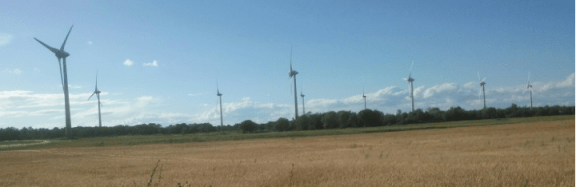
Both countries excel in the food they grow, which is surprising given the short growing season and marginal conditions. Makes one think of how much New Zealand could do given our ideal growing climate, soils and water availability. windmillsRenewable energy (solar and wind) has had major investment and wind mills and solar panels are everywhere.
There are lots of home gardens but not so many farmer’s markets. I visited a few organic bio-dynamic farms staffed by young people (the equivalent of woofers). When winter hits they all head to warmer climates. There are good distribution systems linking organic growers in Scandinavia to the public.

Recycling is very big around domestic and agricultural waste (e.g. all thatch left after wheat harvest is bailed and stored to burn for water heating). Animal waste is recycled back to the fields in a precise fashion. The European Union has regulated how much fertiliser  farmers are permitted to use based on soil type, crops grown and harvested etc. This has all come about due to the Baltic Sea becoming eutrophic due to agricultural runoff.
Bikes rule and are given priority over cars in cities and rural areas where separate bike paths have been built adjacent to highways.
bikes-rule
New Zealand has a lot to learn from these countries in relation to renewable energy, recycling – especially agricultural and wood waste, bike infrastructure, and looking after each other.

A Local Food Northland conference?

Local Food Northland is in the early stages of planning a local food conference. A big part of the shift to a more sustainable food systems is working together – so the diverse people and groups that have an interest in food and health can learn about what each other are doing and build productive connections.

We are still finalising the dates and venue, but it could be as early as February 2017. We are talking with a potential keynote speaker from the U.S. who has a prominent role in promoting food policy initiatives.

farm-to-plate-25-goals

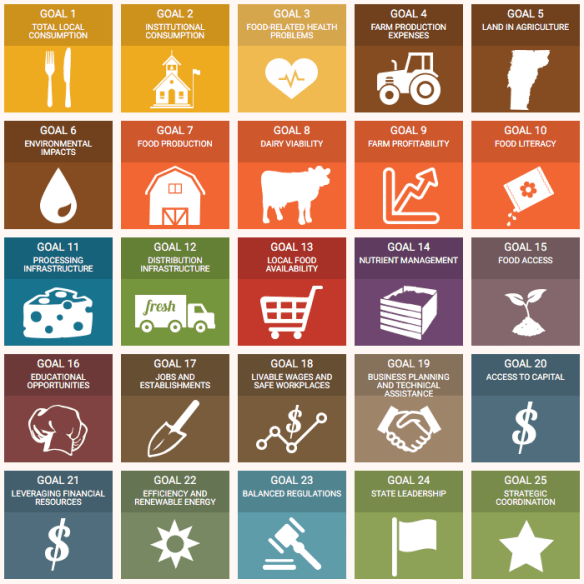
These are the 25 goals for Vermont’s Farm to Plate strategic plan. It makes sense to adapt this for our own purposes and part of the conference will be about shaping up some of these goals in the Northland context. A sustainable food system in Northland has to be grounded in our Treaty partnership, so we will make some room for one or two goals specifically focusing on kai Māori.

Notice that many of these goals are focused on commercial food production and distribution, others are about food related aspects of social and environmental sustainability and others are about policy.

Which of these goals motivate you? If you can see yourself being involved in promoting one or more specific goals, please contact us. You can leave a comment below, or contact Jeff Griggs, Clive McKegg or Peter Bruce-Iri.

A better environment and sustainable food systems

We waste too much food because it is too cheap according to Jason Clay, the Senior Vice-President for Market Transformation at the World Wildlife Fund. If we were to include the cost of the impact of food production (the externalities) food would cost twice as much. The World Wildlife Fund was established over 50 years ago to protect nature, but faced with the enormity of the task, 20 years ago they determined that food production  was the biggest threat to biodiversity.

“the single largest threat to every place is where and how we produce food”

In his 2010 Ted talk Jason Clay identified that 300 to 500 companies control 70% of the connections between producers and consumers in each commodity. Just 100 companies control 25% of that trade. These companies are typically motivated to optimise their profits and the food supply chains continue to get longer. As value is extracted in the middle of the chain, the rewards for producers diminish. Ironically and tragically, millions of small farmers don’t have enough food.

jason-clay-ted

The bottleneck in food systems (from Jason Clay’s TED talk, 2010)

Jason Clay’s thinking is directly relevant to Northland and our move to more sustainable food systems. We want to see more local producers, less processed food and closer connections between producers and consumers.

The other important work for the World Wildlife Fund is working with inefficient  producers that tend to create more damage environmentally and the failure of governments to enforce regulations – again relevant in Northland.

Jason Clay is in New Zealand now. Listen to Kathryn Ryan’s interview here. Here is his 2010 TED Talk.

Free fish heads

Here is a great example of software facilitating better resource use. The ability of software to facilitate direct connections between producers and consumers are important in developing more sustainable food systems – in this case, reducing food waste.

Free Fish Heads from Tightlines Television on Vimeo.

Here is a link to Free Fish Heads.

Co-operatives

Ken Ross returned recently from Italy excited about their co-operatives. The Emilia Romagna region is one of the most prosperous in Europe and the home of luxury car manufacturers, Ferrari, Lamborghini, Maserati and Ducati. It has a population of 4.5 million with two out of every three citizens in co-operatives. This Prezi has more background.

emilia-romagna

This map of Emilia Romagna shows the range of produce common in the region. Click here for a larger image.

The roots of the co-operative movement in Italy were in the nineteenth century. Visionaries promoted collective economic enterprises, not based on individualism and self-interest. In this interview, Italian academic Vera Zamagni also identifies socialist and Catholic foundations for the movement. More recently, Article 45 of the Italian Constitution, lays a solid policy foundation for co-operatives, for example, one person, one vote.

Vera Zamagni identifies four types of co-operatives.

  1. User co-ops – for collective access of goods and services.
  2. Producer co-ops –  such as farmer co-ops.
  3. Social co-ops – delivering personal services such as health services.
  4. Worker co-ops – where workers supply capital and participate directly in management.

New Zealand agriculture has a strong co-operative tradition, but without the constitutional protection of “one person, one vote” these typically evolve to control by a managerialism with a consequent alienation of members. Faggiola is one example of co-operative food production in Northern Italy.

“…cooperatives tend to humanize the market because of their rules of functioning: the person – the member – is at the centre, not capital”. (Vera Zamagni)

Kaicycle- food waste recycling

Wellington’s Kaicycle is supporting the shift to sustainable food systems with urban food waste recycling. They use bikes to collect organic waste from homes and businesses, compost it, and use that compost to grow food. Half of that food is given away to organisations such as Kaibosh.

It is inspiring to see sustainability embedded in their business model. Their bikes make their operation carbon neutral, they reduce organic waste going to landfills, and grow food to provide better access for those in need.

Here is a Radio New Zealand interview about Kaicycle.


A Food Policy Council for Northland?

While current sustainable food system initiatives in Northland are admirable, as yet, they remain relatively poorly connected. If this were to continue, such initiatives will remain as a counter-culture in the prevailing industrial food system. Local Food Northland believe that developing a Northland food policy council, founded democratically as a “grass-roots” initiative with the task of preparing a regional food plan and fostering greater connectivity is a desirable step toward a more sustainable food system.

Here is  an extract about food policy councils from our current research.

It is not surprising that we find strong momentum towards establishing sustainable food systems in the nation that has been at the forefront of the proliferation of fast food chains, food processing and long food chains. In 2015, The United States had 215 Food Policy Councils, with a total of 282 in North America.

Screen Shot 2016-08-20 at 11.15.43 AM

Food Policy Councils in North America

This graph (from John Hopkins Center for a Livable Future) reveals dramatic growth in Councils from 2000 to 2015. Growth appears to have plateaued, but based on its proliferation in North America is primed to expand in other locations world-wide.

Seventy eight percent of these councils are either independent grass-roots organisations or NGOs with Twenty one percent embedded in government or government funded organisations (Center for a Livable Future, 2015).

The Center for a Livable Future’s mission is “to promote research and to develop and communicate information about the complex interrelationships among diet, food production, environment, and human health” (Center for a Livable Future, 2016). The top priorities for Food Policy Councils are healthy food access, urban agriculture/food production, education, purchasing and procurements, networking and food hubs. Other interests are anti-hunger, food waste and fitness(Center for a Livable Future, 2015).

Two examples of Food Policy Councils follow – the first metropolitan and the second regional.

The Toronto Food Policy Council (TFPC)

The Toronto Food Policy Council, established in 1991 is one of the oldest. The TFPC “connects diverse people from the food, farming and community sector to develop innovative policies and projects that support a health-focused food system, and provides a forum for action across the food system” (Toronto Food Policy Council, 2016).

Key documents include the Toronto Food Charter and Cultivating Food Connections, Toronto Food Strategy. The TFPC also collaborates with other organisations in Ontario to promote policy and legislation to shape a sustainable food system. Wayne Roberts (2014) uses a flywheel as a metaphor for food policy councils. They institutionalise and foster innovation providing momentum, rather than having new projects have to start unaided and poorly connected to the diversity in the food system.

Puget Sound Regional Food Policy Council (PSRFPC)

The PSRFPC is much younger, established in 2010. Its vision is a “thriving, inclusive and just local and regional food system that enhances the health of: people, diverse communities, economies, and environments”(Puget Sound Regional Food Policy Council, 2011). In addition to policy work, the PSRFPC has worked on farmers market viability.

Local food and climate change

We have to change our narrative around climate change. Our government tells us that we are too small here in New Zealand to make any positive impact on climate change. But we have been leaders in social change. We were the first nation to give women the vote in 1893, we have been world leaders in social policy and were the first in the Western alliance to take significant action against nuclear proliferation. We can lead with climate change do – or at least do our bit to help.

Growing the local food system generates multiple benefits for the community. As we strengthen the system, we anticipate benefits for health and local economies. Into this mix we can create further synergies by including strategies for climate change mitigation.

A recent NZ Herald article by Victoria Ransom and Phillip Mills highlight the benefits of carbon sequestration in trees and soil. If we were to plant 187 million permanent native trees by 2030, we could return to 1990 emission levels. That’s 40 trees for every New Zealander or 6.3 million trees in Northland. And we can anticipate that displacing oil with renewables will enhance these gains.

Ministry of Agriculture and Fisheries data reports sequestration rates ranging from 7tonnes of CO2/ha for unimproved pasture to 1238 tonnes of CO2/ha for lowland podocarp broadleaf forest. Mixed manuka/kanuka scrubland ranges between 238 and 554 tonnes of CO2/ha.

plantings benefits

Imagine if we were to accelerate the rate of plantings around waterways, roadways and city streets. We can create food forests in urban areas and food for bees in rural areas. As our waterways become more protected by a mantle of trees, less sediment and nutrient flows into the water and water quality improves. The network of green corridors enhances birdlife and makes our region even more beautiful. And these efforts sequester carbon hopefully protecting us from the worst impacts of climate change.

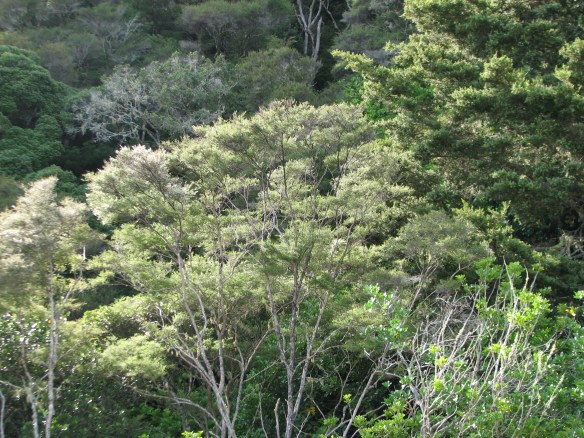
Kanuka is a great option for planting. It grows much bigger than its cousin manuka, reaching up to 18 metres. While not sequestering as much carbon as denser mixed forest, it  sequesters much more than pasture. The honey has qualities as least as good as manuka.

The impacts of climate change are scary and seem to be intensifying more quickly than most of us anticipated. Its time to shake of our inaction knowing that we have options, and individuals can make a difference.

kanuka

Kanuka (Kunzea ericoidies) grows to an impressive size and its early summer floral displays are under-rated.