Food evolution and health in Aotearoa, part three: Consumerism

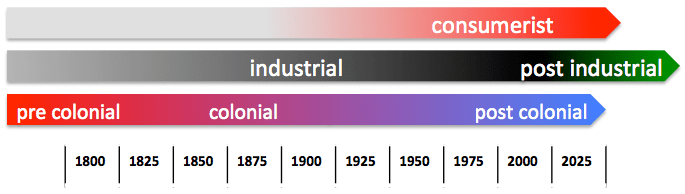
The first post in this series explored colonisation, and the second explored industrialisation as formative forces in our food system. This post explores the impact of consumerism.

food evolution aotearoa

Consumerism

This video traces the origins of consumerism to the 18th century. It coincides with the emergence of the Industrial Revolution. It poses an interesting question: could we design a society where consumerism and high-mindedness are not polar opposites – might we have wealth and virtue, rather than the stark choice of consumerism or poverty?

Consumerism was supercharged after World War Two. Industrial capacity mushroomed to equip the war effort and all of that enterprise had to find new markets. Marketers aligned production systems with a rethinking of societal design, to optimise market opportunities. The industrial machine was at full steam and needed willing customers. Victor Lebow articulated a new creed of consumerism.

“Our enormously productive economy … demands that we make consumption our way of life, that we convert the buying of goods into rituals, that we seek our spiritual satisfaction, our ego satisfaction in consumption… We need things consumed, burned up, replaced and discarded at an ever-accelerating rate.” (Victor Lebow, in the Journal of Retailing, 1955)

The marketers had new tools to shape the developing consumerist culture. Television offered unprecedented access for marketers into family homes.

“And television achieves three results to an extent no other advertising medium has ever approached. First, it creates a captive audience. Second, it submits that audience to the most intensive indoctrination. Third, it operates on the entire family. “(Victor Lebow, in the Journal of Retailing, 1955)

Another foundation of the consumerist culture were the concepts of planned obsolescence and perceived obsolescence as explained in this video (starting at 12 minutes 40 seconds).

Perhaps the purest expression of perceived obsolescence (so far) is the smart phone, with new models offing possibly a marginally larger screen or a flasher camera, generating shopping frenzy. What’s next?

Consumerism and food

At the heart of many of the problems we identify with food is its change of status from something for nourishment to a marketable commodity. The need for industrial food manufacturers to enable food to last on long journeys to market and in warehouses and on shop shelves has necessitated processing. Sugar and salt preserve. Pasteurisation slows down decomposition and dehydration and chemical additives extend shelf life.

Unlike industrialisation and colonisation consumerism appears to march on virtually uncontested. Victor Lebow and his like have shaped our behaviour more profoundly than he ever could have imagined.


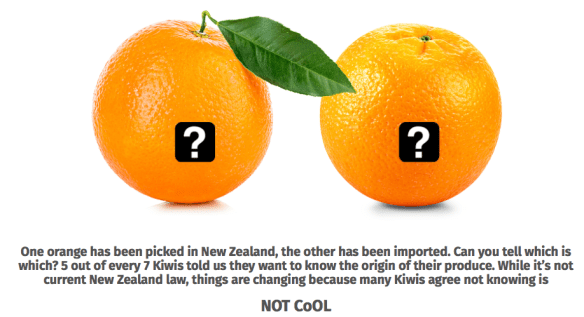
CoOL; Country of origin labelling

HortNZ is working hard to support the Consumer’s Right to Know (Country of Origin of Food) Bill. You can keep informed about the progress of the bill through a Facebook page.

Submissions on the bill close on 18 May 2017. You can also send a message to your M.P. through this website.

Screen Shot 2017-05-15 at 7.12.00 AM

Conference videos are out!

Thanks to Channel North for doing a great job of covering our conference. Thanks also to Northland Inc for supporting production of these videos. This short video provides an overview of the conference.

We are in the process of uploading videos and you can access them from our conference pages.

Here is the first of our two keynote speakers, Anne Palmer of the Center for a Livable Future  at Johns Hopkins University.

Food evolution and health in Aotearoa, part two

The first post in this series explored colonisation, one of three formative forces in our food system. This post explores the impact of industrialisation.

food evolution aotearoa

Industrialisation

First up, let’s acknowledge that industrialisation has delivered massive benefits for humanity – the technology we enjoy, rail, road, sea, air and even space travel to name just a few. Is it possible that we can continue to enjoy the benefits of industrialisation while minimising its downside? I would like to think so.

New Zealand as a nation is less than 200 years old and our development parallels the growth of industrialisation. When Captain Cook travelled here in 1769  James Watt patented his steam engine – the first machine to have a significant impact in commerce. Jeremy Rifkin identifies three industrial revolutions, the first driven by steam, the second  by oil, and the third by renewable energy.

In the 1860s the first railways began to connect the country. The famous SS Dunedin was a wind -powered ship, but its steam driven refrigeration system enabled us to deliver the first shipment of frozen meat to England in 1882. By then, steamships had started to appear too cutting a month off the long sea journey to England. Steam engines started to have an impact in food production from the 1860s with machines used initially for threshing grain.

Oil – the second industrial revolution

The second industrial revolution saw oil accelerate industrialisation and revolutionise food production in a variety of ways.

1. Mass production

Henry Ford’s 1920s revolutionary production line established a template for mass-production that was manifested here on the production line of freezing works.  Farms became bigger as the machinery of industrialisation enabled the processing of meat. “The Meatrix” traces how this process led to the development of factory farming in the U.S. While we still have a lot of grass fed beef and sheep-meat, most of our chickens and pigs are farmed this way.

2. Processing for longevity

The two world wars were industrial wars, driven by oil, with the combatants’ industrial prowess ultimately determining the outcome. Wars can only be won when armies have effective supply chains, and these wars required massive supply chains, on a scale never seen before. War drives innovation. We flew into the Second World War in biplanes and flew out in jets. Innovation in supply chains was just as remarkable, if not so visible.

Tim Lang of The Guardian identifies this as the beginning of the end for farmer domination of the food system.

Until the second world war, it was the farmers who were the major players in food. But the end of farmer power began just when they thought they were at their most powerful – in the middle of the 20th century. After the war, they were given grants and subsidies, but these were merely to stop them collapsing altogether. They were supported but only so long as they restructured: in return for intensification, increasing efficiency and the adoption of labour-saving technologies in the form of agrochemicals, machinery and plant science.

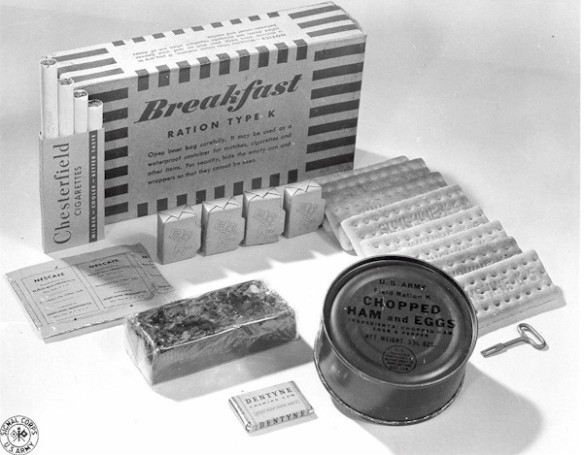
Canned food became a staple in World War One and its production accelerated for the second, much larger war. The U.S. developed K-rations to provide food that was long-lasting and easy to transport.

KRation_Breakfast

A K-Ration breakfast from WWII – note the can of chopped ham and eggs (image from Wikipedia)

You can imagine how quickly the companies that produced these foods sought other markets when the war finished. If you want to see what products will appear in our supermarkets tomorrow, look at the innovations the military is working on now – for example, a sandwich that will stay fresh for two years.

Another innovation was DDT – the insecticide that caused the Second World War to be the first to have fewer people killed by diseases that bullets. Very quickly, other agrochemical innovations appeared, including 2,4,-D in 1944. You can imagine how quickly the agrochemical companies sought new markets when hostilities ceased.

Combined with the impacts of consumerism, industrialisation transformed our diets over the remainder of the century. The Green Revolution in the years from the 1930s to the 1960s that saw continued innovation that led to massive increases in agricultural production world-wide. But has it been successful?

The legacy of the industrial food system

The International Panel of Experts on Sustainable Food Systems released the report  From Uniformity to Diversity: A paradigm shift from industrial agriculture to diversified agroecological systems. The report highlights the downside of the the industrial food system.

Today’s food and farming systems have succeeded in supplying large volumes of foods to global markets, but are generating negative outcomes on multiple fronts: wide- spread degradation of land, water and ecosystems; high GHG emissions; biodiversity losses; persistent hunger and micro-nutrient deficiencies alongside the rapid rise of obesity and diet-related diseases; and livelihood stresses for farmers around the world.

The impact on human health is a massive industrial food system report card fail, with the health of close to five billion of the world’s seven billion people not getting good health outcomes.

iPES Food industrial food systems failure

New Zealanders are impacted by these trends. To return to the question posed above, how we can continue to enjoy the benefits of industrialisation while minimising its downside?

The first post in this series explored the impact of colonisation on Māori. Have we all been colonised by the forces of industrialisation?

Part three of this series will explore the impact of consumerism on food evolution.

Tropical Fruit Growers is on a roll!

On 8 April Tropical Fruit Growers New Zealand had their inaugural public meeting at Northland Inc’s Orchard. Attendance exceeded expectations and now the TFGNZ has over 100 members. Here is Hugh’s report from the meeting. Some images are added from the TFGNZ Facebook page

What a meeting! Thank you everybody for your support and TFGNZ is all go.

TFGNZ is the result of a group of people – all passionate about what they are growing – getting together, discussing, sharing and comparing what they are doing and what is possible.

TFGNZ committee

The TFGNZ committee – from the foreground in the left, Cameron Smith, Owen Schafli, Hugh Rose, Brent Burge, David Colley and Matt Stanley

The most important asset of TFGNZ is our  Members. With that in mind I would like to set out the immediate agenda as I see it and welcome suggestions to take to the next committee meeting.

The commercial growing of bananas in Northland is not a new idea but for one reason or another it has never gotten off the ground. With the downturn in the dairy economy the time is right for this to happen and I intend over the winter months get TFGNZ in front of the dairy industry so we are seen as the authority for expanding the planting of banana crops to supplement incomes and provide inexpensive feed for animals. This is a win-win situation all round as bananas quickly convert effluent into biomass and clean-up waterways.

We need to complete the incorporated society process,  Once this is done we can apply for funding for funding into research as to the nutritional benefits of banana plants for cattle feed and the nutrient levels of the locally grown fruit compared to imported fruit. As I understand it we will be able to receive funding for this research from M.P.I and other agencies.

Please, if you have any bananas growing that you are able to add to the crop register please let us know or contact Matt Stanley  matt@maplekiwi.com who is compiling a database of source materials.

TFGNZ will introduce its own system to identify commercially grown produce and certify organic status or otherwise.

October onwards is the planting out season for bananas so in September land needs to be cleared and stems harvested. We will coordinate teams for this purpose as required. We will be able to get existing work crews to head out and collect the stems and plant them on a grand scale by working in with the various existing agencies as each hectare of land will require over 1000 plants.

These plants are anticipated to be sold at around $10 each with a minimum of $1 per stem going to fund TFGNZ so any donated stems will help operational costs in the early stages. Organising new plantings advising on existing plantation will greatly increase the TFGNZ profile.

With commercial plantings they will initially be done with donated and low cost stems, different varieties going into each plantation. These initial stems will be monitored and those that produce the best results at each location will be cloned using tissue culture techniques to fast track the establishment of viable orchards.

As fruit comes into production then the distribution process will coordinate the flow of fruit so it reaches the consumer in optimum condition and those requirement figures are staggering!

Population of Northland is 171,400.  At 18Kg per person per year, that makes 3085 tons consumed annually.

Population of NZ is 4,781,000.  At 18Kg per person, that makes 86,000 tons.

At $2 per kg that’s 172 million dollars with which to create employment and industry for Northland and who knows in time there may even be some to export!

A small percentage of this will fund TFGNZ

Recruitment within TFGNZ is the first place to start, if you are skilled or able and if TFGNZ is seeking to achieve anything that you may be capable of doing then there is no reason provided you can do it you should not get the job. As each step is taken we will tell members what we are doing and where we are at.  Please let us know if you can help achieve our gaols in any way and if you are prepared to serve on the committee

It’s not all about bananas!

Field trips are to be organised and other activities if anyone wishes to help in this area please let us know don’t be shy, if you have any skills you think may be useful same applies. This is a voluntary role however expenses will be met.

Owens pineapples

Owen’s pineapples sheltered by sugar cane – there are also coffee trees growing in the background

Lastly my bombshell for those who know me – you heard it here first!

Rukuwai Farm is about to go on the market! Yes up for sale and why, you may ask? Six months ago we applied to WDC to subdivide so we could sell off our house and rebuild down where I do all the growing, plantation/market garden and create a water garden to display Pauline’s Lotus plants. Sadly six months on owing to the constraints of the resource management act nothing has progressed other than the depletion of our reserves as yet another report is required. Please do not think I am having a go at WDC far from it, simply it is the framework they are obliged to work within under the resource management act however when you are 65 years of age and have still got lots to do six months is far too long for us!  So we have made an offer on another property which if accepted will see us relocating – not far but it will be to a place that needs some TLC and meets our criteria for water gardens and tropical fruit.

Of course if you know anyone who wants a production platform mostly flat river silt around 100 acres with proven horticultural returns, a nice new modest home, heaps of plantings and a developing banana plantation give me a call.

We are heading into the long weekends so please, take care everybody, enjoy the break and after the committee meeting and debrief on the 18th our very first newsletter will be issued!

What is policy and how do we change it?

How change happens duncan greenOn the cusp of establishing a Northland Food Policy Council (or whatever we might call it) I have stumbled across a book that has thrown a lot of light on the policy universe. In How Change Happens, Duncan Green shares his knowledge as a long-time advocate for change. The book is available for sale, but is also free on Duncan’s website. The complexity of the policy environment is perhaps best expressed in the author’s quote of former British Prime Minister, Gordon Brown.
“In establishing the rule of law, the first five centuries are the hardest”.

This poses a compelling challenge for New Zealanders. Our nation is less than two centuries old. But hopefully we aren’t in for another three centuries of hard work. After all, we have the legacy of tikanga, British law and a broader and deeper legacy pieced together over humanity’s long social evolution.

Two pathways – global and local

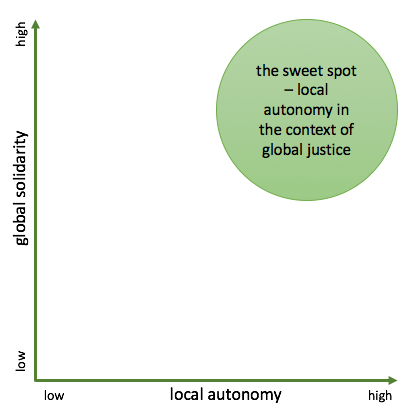
Two trends encourage. The first is the growing body of international policy ranging from law to aspirational statements. Two highly relevant to sustainable food systems are the Sustainable Development Goals and the Global Economic Ethic. The International Panel of Experts on Sustainable Food Systems are also shaping policy discourse at the global level. This trend seeks to distill universal values and principles to guide our peaceful and prosperous development.  For example, the Global Economic Ethic  advocates of the “principle of humanity” as the ethical yardstick for all economic action based on sustainability, respect, fair cooperation and the Golden Rule. These are underpinned by basic values for doing business globally:

  • non-violence and respect for life
  • justice and solidarity
  • honesty and tolerance
  • mutual respect and partnership.

The other emerging trend is toward greater local autonomy and self-determination. While hegemonic forces herd us like sheep towards a bland global consumerist culture, there is an encouraging shift in the opposite direction towards localism. Ideally, the most basic social unit, the family, will have autonomy to act within the broad parameters of evolving global policy.

global and localIn the context of food, ideally families will have choice to eat food that nourishes without their perception being clouded by commercial considerations – especially the rapacious food and medical corporations that privilege profit over health and well-being.
Valuing pluralism

According to Google, pluralism is “a condition or system in which two or more states, groups, principles, sources of authority, etc., coexist.” In New Zealand, almost two centuries on from the birth of our nation we are struggling to come to terms with pluralism. Nineteenth century assumptions of European superiority created homogenising conceptions of right and wrong. Some are still clinging to a Eurocentric view of the world. From this perspective the only valid law comes from Western sources and the maxim “one law for all” dominates.

Before Europeans arrived here, Māori society functioned on its own indigenous policy framework – tikanga. The Māori Dictionary’s definition of tikanga embraces a range of synonyms for policy and related social regulation:

“The correct procedure, custom, habit, lore, method, manner, rule, way, code, meaning, plan, practice, convention, protocol – the customary system of values and practices that have developed over time and are deeply embedded in the social context.”

Tikanga is itself pluralistic as it varies from place to place, and the authorities are the people of any particular location. Many Pākehā have struggled to accomodate tikanga in an unwavering belief in “one law for all” (as long as they get to determine who makes those laws). An example is the justice system. Although Māori constitute 15% of the population, they account for 51% of the male prison population. But attempts to develop the mare-based justice system are stymied by the “one law for all” mantra. Duncan Green observes that “customary (indigenous) law is often about making peace and reconciliation, rather than establishing guilt and redress” (page 104). Customary law can also be brutal. Duncan green advises us to both avoid a “west-is-best bias and a naive romanticism about the woking of customary systems” (page 106).

However, we can achieve a greater synergy between these two traditions in ways that best serve local communities. Can you see a future where this is the case? Do you pass F. Scott Fitzgerald’s intelligence test?

“The test of a first-rate intelligence is the ability to hold two opposed ideas in mind at the same time and still retain the ability to function.”

There are signs of hope as co-governance agreements between Māori authorities and the crown become more common. The recent determination of the Whanganui River as a legal “person” is an encouraging sign. Is this any stranger than a corporation being a legal person (as they have been for the last 150 years)?

The interaction of the various actors involved in developing food policy in new Zealand will be greatly enhanced by Māori input. Ever since the accelerated alienation of their land in the mid 1800s, Māori have engaged in the struggle for justice, working through the courts and government. Their longer-term view of investment, focus on kaitiakitanga and commitment to retaining the land make them a powerful constituent of the food movement.

This is an attempt to explore some elements of policy. More will follow.

EVs for the Whangarei District Council!


Update: The Whangarei District Council passed the remits! Its good to live in a city with visionary governance 🙂


Councillor Stuart Bell has tabled a supplementary agenda item for the Council’s meeting on Thursday 30th March – this Thursday!

2. Proposed motion

  1. That Council, before 30 June 2017, adopt an ‘electric first’ vehicle policy to transition our vehicle fleet to full battery and plug-in-hybrid electric vehicles as the current fuel powered vehicles are due for replacement.
  2. That Council applies to the Low Emission Vehicles Contestable Fund to assist with the development of infrastructure within the Whangarei District to encourage, accelerate and support the uptake of electric vehicles by businesses and private individuals.
This is a real opportunity for our District Council to go electric! Please urge your ward councillors to vote in favour (contact details here).
Please encourage your Councillor to support this motion. Think also about asking your employer to make a similar move. If you want more information about fleet purchases, Joe Camuso at the Northland Regional Council will be able to help.
The-EV-Highway-Northlands-EV-Expansion-PIC-4-caption-Joe-Camuso-Northland-Regional-Council

Joe Camuso is a strong advocate for evs and has recently secured further additions to the Regional Council’s fleet. 

Range anxiety

The most popular option for Whangarei ev drivers has been the Nissan Leaf. With newer Leafs (Leaves?) featuring a 30 kw battery, range has now increased to about 170 km – more than enough for most of our daily commutes.


Archeological evidence of pre-European gardens at Whangarei

Heritage New Zealand is hosting “a short archeological walk” that reveals evidence of both pre European gardens and early European settlement. Meet at the riverside of Hatea Drive opposite the Settlers Hotel at 12 noon on Saturday 8 April. Go to their website for more details.

Food evolution and health in Aotearoa

Our focus at Local Food Northland is about the shift from industrial food systems to sustainable food systems. For us to better understand our current food system reality, we look back to look forward. This is the first of three posts to explore the tides of history that have shaped our food system.

Two hundred years ago was mostly populated by Māori and they ate mostly fresh food – some was dried for preservation or perhaps fermented. Over the last two centuries our dietary patterns have changed dramatically. In conjunction with changes in health care we have longer life spans, but the consequence of our twenty first century diet is an alarming increase in diet-related disease. As my colleague at NorthTec, Nigel Studdart writes:

We are what we eat and what we are becoming is an increasingly overweight and unhealthy population.

There are three major drivers of dietary change in Aotearoa, the impacts of colonisation, industrialisation and consumerism.

food evolution aotearoa

Colonisation

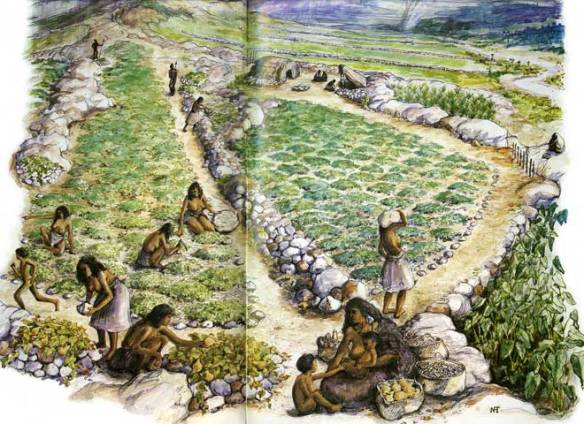
Before the arrival of Europeans, Māori were isolated in Aotearoa and there was therefore no imported food. Neither was food processed beyond cooking, drying or fermenting.

1700s garden

This image from Te Ara is an artist’s impression of a 1700s garden in the Auckland region (drawing by Nancy Tichborne). 

Gardens were community enterprises with crops grown including taro, hue (gourds) and kumara. Helen Leach’s book 1,000 Years of Gardening in New Zealand documents pre-colonial gardening. It includes a drawing by one of Captain Cook’s crew of an East Coast garden with kumara, yam, taro and gourd.

According to Te Ara (The Encyclopaedia of New Zealand) Māori had a life expectancy of about 30. This is low, but better than that of Britain at the time. But “by 1891 the estimated life expectancy of Māori men was 25 and that of women was just 23 (Te Ara). We cannot attribute this to diet, as disease, alienation from land, war, and war’s inevitable consequence, poverty, saw population decline and life expectancy reduce.

Māori adapted quickly to the new foods bought by Europeans, soon producing large quantities of food including potatoes, fruit and meat. By the mid 1800s, Māori were producing flour in their own mills from their own wheat.

Imported foods began to supplement local diets and the appetite for sugar was such that the Chelsea Sugar Refinery was established in 1883. Sugar is increasingly associated with the incidence of non-communicable disease (NCDs). In a food environment where Māori were struggling with the aftermath of war, European diseases, land alienation and the impact of tobacco and alcohol, sugar became another health burden. The world view of the colonialists was shaped in part by social Darwinism and assumption of the innate superiority of Europeans, especially English. In this context, Dr Isaac Featherson said it was the duty of Europeans to “smooth down … [the] dying pillow’ of the Māori race.” Thus the food landscape for Māori in the second half of the nineteenth century was not conducive to health.

The communal approach to gardening was probably one factor that enabled Māori to sustain and recover the population.

Maori population graph

This graph (from Te Ara) shows Māori population from 1841 to 2006.The decline post-Treaty took almost a century to recover. Arguably, the homogenising of assumptions of colonisation continued largely uncontested and dissenting voices unheard through the middle decades of the twentieth century.  The Māori renaissance of the late twentieth century laid the foundation for reshaping the food environment, but the forces of industrialisation and consumerism invoked another form of colonisation that dominated the food landscape as we shall see in the next two posts on this topic.


Is the food policy pasture greener in New Zealand?

Anne_Palmer-reducedBy Anne Palmer

Program Director
Food Communities & Public Health Program
Center for a Livable Future
Johns Hopkins University

Anne was a keynote speaker for the Local Food Northland Conference in February this year. In this post she reflects on her time in New Zealand. See the original post here.


A failing dairy industry. Streams polluted by animal manure. Consolidated food retail, inadequate slaughter facilities for small – and medium-size producers, the list goes on. Where am I? New Zealand. Yep. Before I stepped foot on the soil, I was cautioned that I should not believe the “cleaner, greener” moniker. I’m not sure if it was heartening to blow up the myth and realize we are all suffering from industrialization of the food system, or just depressing that problems in the food system are dispersed so far and wide.
The solutions are dispersed, too. Back in September, Peter Bruce-Iri from Local Food Northland invited me to New Zealand to keynote and participate in a two-day food conference. He had studied the food council model and wanted to introduce it as part of a larger strategy for rebuilding the Northland’s regional food system. It took me about 30 seconds to make my decision (even with my carbon footprint in mind). How could I say no to New Zealand? Peter suggested additional connections for me to make my trip even more meaningful, including a webinar for the Good Food Network organized by Emily Dowding-Smith from the Sustainable Business Network and a workshop with Healthy Families Rotorua, arranged by Jasmin Jackson.The original plan was to hold an advance food-foraging event that would provide food for the conference. (I imagined myself in an Omnivore’s Dilemma scenario, but the wild boar would remind me of Wilbur in Charlotte’s Web). That plan was thwarted by regulations that prohibit the sale of food that has been “caught wild.” Nevertheless, thanks to Ian and his sous chefs, I gained three pounds in eight days. And every pound was worth it. Even though we were unable to forage for our meals, most of the delicious food was sourced locally.

I spent my Saturday morning at the Whangarei Growers Market with Jeff Griggs, a co-founder of the Local Food Northland endeavor. Jeff is an American who immigrated to New Zealand many years ago and now farms avocados and cut flowers, along with other produce like kiwifruit outside of town with his dog, Ted. The oldest growers market in New Zealand, Whangarei Growers Market regulates that you can only sell what you grow, and Robert, the market manager and 70-year-old farmer, explained he has no problem tracking down the offenders because the produce looks different. I watched him collect the $20 stall fee from vendors while we shopped for Luisa plums, blueberries and lavender products. (Note to self: organize trips based on seasonal harvesting schedules).

After the market, Jeff invited me to join the weekly Whangarei Transition Town meeting at the local library where residents discuss ways they can improve self-sufficiency at the local level. Originating in the UK in 2006, the Transition Towns movement seeks to address peak oil and climate change, and challenge the notion of unlimited economic growth. We had a lively discussion about school gardens, people’s eating habits, electric cars (thanks, Ross) and more.

handsome frog

And now on to the conference. Close to 100 people gathered at the marae (including students from North-Tec, growers, public health professionals, chefs and researchers) for the powhiri, a traditional Maori welcome. Whangarei’s mayor, Sheryl Mai, also welcomed us in Maori. Participants lined up to touch foreheads and noses with the planning committee, a Maori greeting called hongi, which symbolizes sharing the breath of life. As a lifelong hugger, this was a reverent experience.I talked about the various food movements in the U.S. with a special focus on what is happening around food policy councils, why policy is important and how the various food movements are working together to activate change. (One participant told me he never thought policy was important until he heard me. Best compliment ever.)

Over the two days, we heard from Peter about the features of a sustainable food system and importance of scale-appropriate policy. Ruth Marsh introduced the Vermont Farm to Plate framework, which Local Food Northland has been using to guide their regional effort. Rangimarie Price talked about how Maori principles on sustainability are embedded in the local food strategy. Jeff discussed how to connect and build a network for collaborating. There was a lively discussion about the role of chefs and restaurants in supporting local producers. While some of the larger cities have capitalized on the farm-to-table concept, in smaller cities like Whangarei, chefs are sourcing from local growers with very little or no marketing efforts.

I joined the policy discussion for the small group breakout and heard Regina, a NorthTec student and single mom who is working with faculty on various food endeavors, bemoan the demise of her kitchen garden this year because she is going to school full-time and raising her four children. I have heard this same conundrum in many focus groups and community meetings in Baltimore; doing the “right thing” frequently falls on the backs of those who have the least amount of time.

On Day Two, we heard from renowned nutrition scientist Barbara Burlingame about sustainable diets and nutritional superiority of native bananas versus the Cavendish variety that is ubiquitous in supermarkets around the world. Northland has a variety that reminds me of passionfruit, and there are discussions about reviving that industry. (Lucky for Northland, Barbara just moved back to Wellington and joined the faculty at Massey University after 16 years at FAO in Rome as the deputy director of the nutrition section). Dr. Melissa Gilbert, an integrative medicine doctor, discussed her efforts to get patients to grow and eat from backyards. Dr. Laupepa Va’a from the district health board talked about food recovery efforts in Northland. A diverse panel of growers debated the challenges they face from a policy and climate perspective, while another panel focused on the role of food hubs in rebuilding distribution systems. Clive McKegg, the third leg of the Local Food Northland founding members (along with Peter and Jeff), wrapped up the conference by discussing how the Local Food Northland’s mission “to establish Northland as a centre for growing and processing tasty healthy foods in ways that build community cohesion, increased economic resilience, improve health outcomes and enhance the natural environment” can be actualized in their collective efforts. I left inspired and remain inspired as I witness the conference follow-up on the Loomio online platform, designed by a New Zealand company.

After my time in Whangarei, I traveled to Rotorua, which was challenging. I liken this part of the journey to the 80s classic movie, Planes, Trains and Automobiles (think Buses, Cars and Hitchhiking). Lucky for me, Hayley, another conference attendee, was scheduled on my flight and she took the reins to get me to my destination that day. I strolled around Rotorua’s thermal lake, careful not to step in a bubbling hole, and enjoyed the hotel’s thermal pools while preparing for the second workshop.

Jasmin Jackson from Healthy Families Rotorua invited me to meet with groups from Rotorua and Tauranga who have been engaged in food and nutrition activities in their area and want to expand to policy. About 45 people attended the workshop, many from the public health sector. Healthy Families, working in 10 locations across New Zealand, is a national initiative that seeks to create health-promoting environments in the community and is involved with food policy efforts in other parts of the country. We talked about the opportunities and challenges associated with local food policy and ideas for strengthening their network. Even with the central government driving most legislation, I learned that New Zealand’s regional government structure offers options for organizing, especially around regulations for small-scale growers, land use, distribution networks and public health. I heard several participants talk about the importance of policy being informed by research, opportunity to expand public health mapping to other food system components and the need to better understand existing supply chains to improve distribution.

I travelled 23 hours to find myself in a beautiful location (since this is a food policy blog, I did not talk about the beautiful beaches, frolicking dolphins or the rails-to-trails bike ride, but those were also remarkable) that is facing many of the same issues we have in the U.S., albeit at a different scale. It is a scale that may serve them well as I witness the conversations among the conference participants already deciding how to move forward. I invite them to share their challenges and successes with us here in Crazy Town, where microwaves spy on you.