Change will come at the local and regional levels

There have been some great results in our local body elections. I am happy that Sheryl Mai has been re-elected in Whangarei. She is a supporter of Local Food Northland, hosting our first formal meeting in her office and is a strong supporter of the Whangarei Growers Market. Tricia Cutforth has been re-elected. She campaigned tirelessly and successfully for the Council to make Whangarei District the first Fair Trade District in New Zealand. It is also good to see Greg Innes re-elected to the WDC – another strong supporter of local food.

sheryl-mai

Sheryl Mai fielding congratulations on her re-election (image from The Northern Advocate).

There is a new Mayor in Kaipara and John Carter has been re-elected in the far North. I would welcome thoughts from residents in these districts about the outcome of their elections. Future posts will explore the election outcomes for the District Health Boards and the Regional Council.

Local body politicians are more likely than national politicians to drive change towards more sustainable food systems. They tend to be more pragmatic and less ideologically bound and will respond to local concerns. The 2015 World Cities Summit Mayors Forum in New York ended with a strong declaration on sustainability.

The Meeting of the Minds Website outlines how mayors in the U.S. are creating sustainable connected cities.

“Cities are the places where we live and interact. We expect our city leaders to keep them healthy, safe and vibrant. Mayors fill the potholes, provide needed services to people and grow the economy. Even more, the nation’s mayors are leading the charge to develop sustainable, livable, smart cities”. from Meeting of the Minds.

Back in New Zealand, Gareth Morgan accuses Mayoral candidates of being “asleep at the wheel” on the junk food problem. Their are encouraging exceptions. Nelson Mayor Rachel Reese has been re-elected. Her she is talking about sugary drinks.

It is said that we get the government we deserve. More local body elections, and eventually national politicians will support the move to more food systems as more of us raise our own expectations and champion the issue.

 

Cheese and why we need a food policy council

Artisan cheese makers like Biddy Fraser-Davies could be forced out of business by soaring government compliance costs. The Food Safety Law Reform Bill may well result in higher compliance costs.

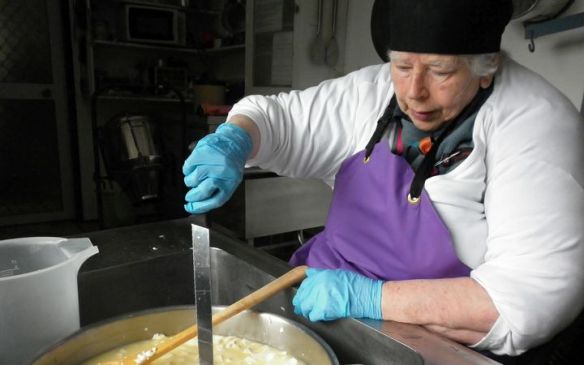
Biddy makes about $40,000 of cheese from four cows. Her cheeses have won super gold and silver at World Cheese Awards. She milks the cows herself and makes the cheese. For images of her cheese making process see Biddy’s website.

eight_col_biddy_making_cheese

Biddy making cheese (image from Radio NZ)

Her cheese is made from raw milk and authorities have concerns about microbes. Before 2009 her compliance costs used to be a couple of hundred dollars a year. That year they went up to $5500. Because of her small scale, her costs now total $260 per kilo (you can read more detail in the Radio NZ article).

This is insane.

Compliance or risk?

One issue is the number of microbes permitted. According to the Radio NZ article, biddy says “In New Zealand it’s been set that you can’t have more than 1000, but in England the level is 10,000 and in Europe it’s 100,000. The raw cheese that is imported into New Zealand is allowed to have those higher standards.”

Many of you will experience creep of compliance in your work or businesses. It would be more appropriate in cases such as Biddy’s to assess risk. A two factor risk assessment process considers both the likelihood and the impact of an adverse event occurring. There was a report of a death from the consumption of raw milk in Australia a year or so ago, but how many rural families have been consuming raw milk for decades? When did you last hear of a health issue around raw milk?  As an international prize-winning cheese maker, we can probably assume that Biddy approaches her craft with a high levels of professionalism. I would assume the likelihood of a health problem from eating her cheese is very low.

With her low volumes of production, the impact would also be low. By contrast, while Fonterra has excellent food safety standards, the impact of a bad batch of cheese would be much higher, based on their scale and global market presence.

The role of a Food Policy Council

Local Food Northland is in the process of researching the feasibility of establishing a Food Policy Council in Northland. This would be modelled on the work of the 282 Food Policy Councils in North America. A Food Policy Council would be a voice in policy for smaller food producers. The state of Vermont, for example has developed a regional plan to restore balance and sanity to regulations. Here is goal 23 of their plan:

“Regulations and enforcement capacity will ensure food safety, be scale appropriate, and allow Vermont food enterprises to increase production and expand their market outlets”.

The key words here are “scale appropriate”. The second part of the goal links increased production and expansion of markets to this scale appropriateness.

It seems that we have a government that pursues big economic numbers, but a strength of our economy is small business. Clumsy compliance will drive more small businesses to the wall. We only have three raw cheese makers in the country. It would be nice to increase that number, but I fear they will disappear.

If we can establish a Food Policy Council in Northland, hopefully they will be replicated around the country, enabling us to make our voice heard.


Isobel.pngBiddy will be speaking at a select committee hearing into the bill on 13 October in Wellington. All power to her and her four cows, Dizzy, Holly, Patsy and Isobel!

And more on raw milk soon.

Here’s Isobel.


A new mid-week market

By Lesley A’Court

Growers are planning a mid week market to provide a daytime and after work venue for business people and others who would like to buy the same fresh vegetables, fruit and produce they already enjoy on Saturday.  Prices will be basically the same along with many stallholders.

Starting Wednesday, October 19th 2.30pm – 6.30pm at the corner of Wood St and Railway Road.


wednesday-market

Genuinely interested stallholders who have the produce to sell, are welcome to give us a ring.

Rules will be few but one essential is that the Grower attends with his own produce.   A member of the family or someone who knows the growing processes well,  can stand in,  BUT there is to  be NO ‘on selling’ of others’ goods.

A Community stall is going to be provided where people can plan to have their veg and fruit etc., (with a 15% commission being charged) sold on their behalf. All growers with produce need to provide some detail of the name of their farm and the most interesting aspect of the crop for display to the buyers.

We have so much interest at present that we may have to look at size of venue, but for the present the new market will run for four weeks before we all have a meeting and swap ideas on our collective findings.  Growers will be expected to arrive for those four Wednesdays, rain, hail or shine by at least 2pm the first day.

For more information contact:

Lesley  A’Court: 09 438 7868  leave a message. Cleared late afternoon.

George Lavich: 021 239 8734

A Local food conference forage

This video, from North Canterbury Vineyards, tells an inspiring story of a food forage banquet.

Perhaps we could do something similar in Northland for the Local Food Northland conference on Monday and Tuesday, 13 and 14 February? Those registering for the conference could join the forage the weekend before. There are deer in the hills here I’m told by a reliable source. There is plenty of fish in the sea in February, lots of blackberries  supplemented with visits to Northland’s fine growers, farmers, beekeepers and home gardens.

Any ideas?

North Canterbury Forage from North Canterbury Vineyards on Vimeo.


What is the value of healthy fresh food?

By Lesley A’Court

Lesley is a well known local grower, selling delicious strawberries, fermented foods and preserves in markets around Northland.

strawberries.png

Image from Home Remedies Natural Cures

Growing and gathering ‘food’ be it fruit, veg, fish, dairying, cereal or collecting honey as a business is a fulltime job. The results are what we all need to keep healthy.

Once if you worked hard at these occupations you were rewarded with enough money to run a family and even once a year manage a modest holiday. (That was about 40 years ago)
Much now is retired people working hard living off a pension.

Since then the world has become faster and more ‘clever’ in the lining of individual pockets that have never soiled their hands. This was at first very useful as the growers could produce more than they could themselves sell at the local outlet. It then grew, and became a much easier way to earn a ‘middle man’s living’. Slowly but very surely the growers became the losers financially, and ended up in most cases being completely dependent on these ‘helpful’ distributers of their goods.

We now have a situation where the tradition of all these hunters and gatherers are not a viable choice for young people, and it becomes a commonly held thread that they all need to leave and ‘go to the city’.

The public haven’t understood this is happening but growers have been slowly ground down so they can’t live off their fulltime job. Many ‘retire’ from a thankless task. Some have gone bankrupt and lose all (think Callas, Sandesonia, deer velvet, ostrich eggs, orchids, recently dairying etc.).

I know growers who are getting the same money for their produce as they did 30years ago!!! Who would stand that in their office job?

About 20 years ago the growers realized that the situation was dire and was caused partly from the poor quality produce arriving from overseas. (if you pick unripe with no sugar content in order to send overseas and have it ripen at the other end, of course it tastes of nothing) and their financial losses were becoming worse through middle men ‘clipping the ticket’ SO… they started up local markets where you could sell fresh, tasty, often tree ripened produce in season. Producers could sell their ‘made yesterday’ beautiful cheeses, yoghurts, sauerkraut, kimchi, kombucha, salamis etc. The growers can expect top quality prices for their top quality food and the customer is fully aware of the history of their purchases and have a good relationship with their supplier.

The idea has taken off worldwide, and is growing. If the producers can earn the correct money for their hard work then the whole community benefits with more money and jobs circulating.

We are going to lose our good growers in NZ if we don’t support them.

Good food markets are not where you go to pick up bargains. Prices should be more than the supermarkets. Quality product deserves quality money, like the rest of sociey earns.


Food as medicine

By Dr Melissa Gilbert

This is the first of hopefully many posts by Dr Melissa Gilbert. It was first published on her blog, The Integrative Doctor.

melissas-harvestI’ve read all the modern whole food books on the trendy bookstore shelves at the moment and I LOVE what’s happening. I love that our attitudes towards food are changing and that we are beginning to understand the true meaning of nourishment. We know now that how we source food is the first and arguably the most important step in the process. Food should be nutrient dense but it should also have a pristine conscience and be laden with good karma.

This all happens well before the food is gathered but contributes monumentally to how that food nourishes and heals our bodies. It’s time for all of us to wake up now, ignorance is no longer an excuse for the pillaging of our planet and quite honestly neither is cost anymore.

Sourcing and preparing healthful food is not about expensive ingredients from the local hipster grocery store. It’s about so much more than that and it starts in our own homes with an attitude analysis followed closely by figuring out what we can do right here, right now.

The first question to ask is, how did the food I have in my house get here? If it came from the other side of the world, is engineered or processed, has additives, added sugar or came from a place where chemicals and it’s carbon footprint are of no mind then change is needed….drastically!

SLOW food isn’t a new concept but it is a way of life that once adopted becomes a source of wellbeing that far surpasses anything experienced so far. Seasonal/Sustainable, Local/Logical, Organic (although karmicly sound is more important than an ‘organic” label) and Whole is the food that will make us better. It is medicine to ensure that our bodies are no longer a hindrance to our learning.

imageThe absence of illness or mediocre wellness is not enough, we must be humming at exactly the right frequency so that we can connect with our whole minds to the truth of our existence. To be distracted by disease, inflammation, fatigue or pain takes us away from the core business of life – to learn and contribute.

A health crisis is not necessary to come to this knowledge, wellness at a higher level can be accessed now. I guess the good and fair questions at this point are around accessibility and equity. The right to be able to live a supremely healthful life is the right of all humans regardless of income, education and location. Awareness and willingness are truly all that is needed for this.

I’m going to mention the obvious in this post but only in passing because the truth is that the knowledge is already intuitive, we just need to tap into it. Foraging and growing food and community gardens and food swaps and trading and sharing and teaching and conserving and preserving and, and, and are already available, already being done, so do it.

If you can’t get online or you can’t get to your local library then go to your nearest neighbour and swap some seeds…the rest will follow.

The Fresh Food Collective achieves 100% local food!

fresh-food-collective-logo

The Fresh Food Collective reached a milestone last Tuesday. For the very first time they achieved 100% locally grown produce. They have often hit 80% and the goal of procuring all produce from local growers with in 12 months seemed at times very challenging.

George Lavich and the team are very excited about achieving this milestone and will continue to work with local growers  to support a sustainable Northland.

Our research has revealed that when locally sourced food replaces food sourced from outside the region, there is a two to four times beneficial economic multiplier of both money and jobs. Customers are getting healthy fresh food at great prices and supporting local growers – a win-win.

George Lavich.png

George Lavich at the Fresh Food Collective’s hub at the Whangarei Club (image from the Northern Advocate)

George, along with David and Sylvia Moore acquired the Fresh Food Collective from Laura Cates in April. Customer numbers are building slowly, but it is clear that for George, David and Sylvia and the volunteers that support them, that they are driven by a strong sense of purpose rather than any financial motive. George is particularly passionate about supporting local growers and is busy seeking out potential suppliers.

The Fresh Food Collective is opening a new hub at the Onerahi Play Centre on Tuesday 20th of October.

Fresh food collective.png

Their $12 and $23 packs offer impressive value and variety. For more information see their website.


Food frontiers

The venue is booked for our Local Food Conference – its all go! It is scheduled for 13 and 14 February  2017 at the Interactive Learning Centre at NorthTec.

anne_palmer-reducedAnne Palmer of the Center for a Livable Future is confirmed as keynote speaker. You can read more about Anne here.

Anne is Program Director for the Food Communities & Public Health Program. One of the roles of the Center for a Livable Future is as an information hub for North America’s 282 food policy councils. This positions the Center to monitor the activities of food policy councils and identify the policies and programmes having the greatest impact.

This documentary highlights some of the positive developments towards more sustainable food systems in the United States. Anne was one of two content advisers for the video.

Who to vote for in the DHB elections?

A big issue we face in local body elections is knowing who to vote for. For those of us interested in moving to more sustainable food systems, the District Health Board (DHB) elections are very important. Our health system remains largely focussed on dealing with primary health care based on orthodox approaches. The massive investment taxpayers make in our health system is captured increasingly by the treatment of non-communicable diseases – for example type 2 diabetes. The default treatments are pharmaceuticals.

I am not qualified in health, but as a person interested in my health and the health of my whanau, I want to see the health system focus much more on nutrition and system change to ensure that all New Zealanders have access to fresh, mostly unprocessed, healthy food. When we achieve this, I am confident that health care will cost a lot less. We will be spending less money on pills and more on food.

Corporate kitchen operators have a reputation nation-wide for cutting corners on the quality of meals delivered to patients. A hospital that feeds, even occasionally, patients biscuits for breakfast, is sending exactly the wrong message to them. Thankfully the Northland DHB was the only DHB to resist the national rollout of pre-packaged meals shipped from out of centralised kitchens. The board insisted that food would continue to be prepared in their hospital’s kitchens. An even better outcome would be to have the kitchen run by local businesses, who purchase directly from local growers.

This reveals two key policies for DHB candidates to champion:

  1. Supporting the localisation of food supplied from hospital kitchens and cafeterias.
  2. Embedding the importance of good nutrition as as a cornerstone of health initiatives.

So far, I know of two candidates for the 2016 elections that are supportive of these aspirations, Debbie Evans and Libby Jones. There may be others – who can you add to the list?

debby-evans libby-jones


Debbie Evans (left) and Libby Jones

Local Food Northland has an aspiration to have 2,000 members by mid 2017. Ideally, in time for the next round of local body elections, we will have at least 5,000. If you want to help us to create a stronger collective voice to influence the policy makers, join us.


Food recovery in Northland

Dr Laupepa Va’a of the Northland District Health Board (DHB) is working on a major project investigating the feasibility of a more integrated approach to food recovery. He is busy engaging people involved in food recovery and food access.

Globally, we waste one third of food produced. The good news is that we produce enough to feed everybody already. This graphic from the Love Food Hate Waste website reveals over one trillion dollars of food waste, most of it from the degradation of nature.

food-waste-iceberg

In New Zealand, the average family throws away $563 worth of uneaten food per year. Bread is at the top of our waste list – we throw out 12,856 tonnes of bread.  Click here for a larger image.

10-foods-nz-throw-away

Reducing our waste is a win-win. In the Northland context, we know that there are many children going to school hungry. Food for Life is doing a great job in Whangarei, but they are only able to operate in a handful of schools. Hungery school children don’t learn very well.

In addition to providing better food access, there are many environmental benefits from reducing food waste.

Sources for food recovery are diverse. In a recent post we featured Free Fish Heads, a website designed to connect those who have fish heads and normally dispose of them, and those who eat them. In Whangarei, Food for Life, operating across the road from the Whangarei Growers Market, gathers unsold food from generous stallholders and turns it into meals for school children.

The challenge is to identify all the potential sources of food and get it to those who are most needy.

If you would like to share any information with Laupepa please contact him: Laupepa.Va’a@northlanddhb.org.nz