Jeff’s travels in Sweden and Denmark

Earlier this month Jeff Griggs returned from visiting Denmark and Sweden. Here are his reflections on his time there.

Both are amazing countries that look after their people. Most are bi-lingual especially the young people. Very old histories makes New Zealand seem very young. They both have high tax rates that pay for a lot of social services. Nobody I met resented this. Both countries are dealing with immigration which is challenging given their social history and openness.

People are very friendly and open. It seems like everybody has summer houses much like the Kiwi bach. The summer is so short that when the weather is fine everybody is out in the sun. Getting sun burnt doesn’t seem to bother them. Summer has long days -light at 4:30 in the morning and still light at 10:00 in the evening. Winters are just the opposite with very short daylight hours.

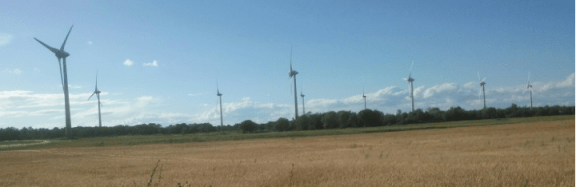
Both countries excel in the food they grow, which is surprising given the short growing season and marginal conditions. Makes one think of how much New Zealand could do given our ideal growing climate, soils and water availability. windmillsRenewable energy (solar and wind) has had major investment and wind mills and solar panels are everywhere.

There are lots of home gardens but not so many farmer’s markets. I visited a few organic bio-dynamic farms staffed by young people (the equivalent of woofers). When winter hits they all head to warmer climates. There are good distribution systems linking organic growers in Scandinavia to the public.

Recycling is very big around domestic and agricultural waste (e.g. all thatch left after wheat harvest is bailed and stored to burn for water heating). Animal waste is recycled back to the fields in a precise fashion. The European Union has regulated how much fertiliser  farmers are permitted to use based on soil type, crops grown and harvested etc. This has all come about due to the Baltic Sea becoming eutrophic due to agricultural runoff.
Bikes rule and are given priority over cars in cities and rural areas where separate bike paths have been built adjacent to highways.
bikes-rule
New Zealand has a lot to learn from these countries in relation to renewable energy, recycling – especially agricultural and wood waste, bike infrastructure, and looking after each other.

Sacred Economics

sacred-economics-cover-art

“Within every institution of our civilization, no matter how ugly or corrupt, there is the germ of something beautiful: the same note at a higher octave. Money is no exception. Its original purpose is simply to connect human gifts with human needs, so that we might all live in greater abundance. How instead money has come to generate scarcity rather than abundance, separation rather than connection, is one of the threads of this book.” (pg 10)

Charles Eisenstein writes with a rare clarity. While I don’t subscribe to all his conclusions, his analysis of the current global economy is spot on, and I’ve learnt much from this book about how the current system has developed, why it has enslaved the world to a cycle of near-irreversible self-destructive consumerism and what some of the keys might be to moving on from this current nightmare.

Connecting human gifts with human needs

Eisenstein’s hypothesis is that society did not develop our present money system as a way to facilitate competitive enterprise in the form of barter as such, but to facilitate mutual gift-giving of resources that would be wasted if not shared. In fact there have been societies that have functioned in a much healthier way without life being denominated in terms of money. He says:

“Let me be very naive for a moment so as to reveal this core, this spiritual (if not historical) essence of money. I have something you need, and I wish to give it to you. So I do, and you feel grateful and desire to give something to me in return. But you don’t have anything I need right now. So instead you give me a token of your gratitude—a useless, pretty thing like a wampum necklace or a piece of silver. That token says, “I have met the needs of other people and earned their gratitude.” Later, when I receive a gift from someone else, I give them that token. Gifts can circulate across vast social distances, and I can receive from people to whom I have nothing to give while still fulfilling my desire to act from the gratitude those gifts inspire within me.” (pg 20)

The fact that human gifts and skills are not being well utilised in our highly developed world (most people don’t love the work they must do) and human needs are very largely unmet through a massive polarisation of wealth illustrates that what we have come to now is an absolute failure.

Instead, money has become a way to reduce human life and the natural world into a reductionist, centrally controllable machine-like and decidedly un-sacred place. He says: “…reductionist science seems to rob the world of its sacredness, since everything becomes one or another combination of a handful of generic building blocks. This conception mirrors our economic system, itself consisting mainly of standardized, generic commodities, job descriptions, processes, data, inputs and outputs, and—most generic of all—money, the ultimate abstraction.” (pg 9)

Instead of enabling well-being for society, our economic system has become the tool of crippling the linking of human gifts and human needs. Money as we know it is not the answer, money is actually the problem.

“It is ironic indeed that money, originally a means of connecting gifts with needs, originally an outgrowth of a sacred gift economy, is now precisely what blocks the blossoming of our desire to give, keeping us in deadening jobs out of economic necessity, and forestalling our most generous impulses with the words, “I can’t afford to do that.”” (pg 22)

Reductionism and commodification

As an accountant by training, I know how powerful the story behind our economic system is, and how hard it is to break out of that mindset. We are trained that everything can be expressed by some sort of a monetary value: time, goods, people, resources, land, water, entertainment, culture etc.

When we link this to the other unquestioned assumptions of our age – maximisation of wealth as expressed in possessions and net worth, and the value of individualism, we have a toxic brew for dehumanisation and destruction of the earth.

Eisenstein shows how society has moved progressively from very little being denominated in monetary terms to almost everything. Much of what was once regarded as the commons – the common property of humanity for the good of all – is now private, protected by private ownership, regulation, patent law, digital rights management and so on.  This has had the effect of not just separating us from our joint cultural heritage but also of separating us from each other and ultimately from our own worth. In a generic world where everything is exchangeablenothing carries any kind of meaning – including our lives.  We see this in western culture where although we have an abundance of stuff we are the most dissatisfied of generations.

“…the products of slave labor embody the spirit that goes into them. Who but a conscript would produce the crappy, dispirited, toxic, ugly, cheap objects and buildings that surround us today? Who but a slave would be so resentful and unpleasant in providing services? The vast majority of our “goods and services” are made by people who only do so for the money, who only do their work because they “have to.” I want to live in a world of beautiful things created by people who love what they do.” (pg 199)

By denominating almost everything in terms of money, we can “own” what was once the possession of all, limit it making it scarce then make a profit. By denominating abundance into money (a scarce commodity) the abundance of the world is withheld from the needy and wasted by the powerful.

“When everything is subject to money, then the scarcity of money makes everything scarce, including the basis of human life and happiness. Such is the life of the slave—one whose actions are compelled by threat to survival. Perhaps the deepest indication of our slavery is the monetization of time.” (pg 31)

The non-organic nature of money

If almost everything is denominated in terms of money, things once intrinsically valuable not only lose meaning and true value, but the status of money is elevated to a higher value than the goods that it is supposed to represent.

Almost everything in the real world decays over time – food, fabrics, timber, manufactured goods, even ideas and culture. They need to be refreshed and nurtured. Even land if left unkept losses some of it’s intrinsic value (an orchard left to become overgrown say). This is why gold was regarded so highly in ancient cultures – it did not rust or decay like everything else.

Money as we know it on the other hand (because it can be loaned at interest) functions in the exact opposite way. It gains value over time. Money, something that has no intrinsic value but is simply supposed to be a way of linking human gifts with human need, has now become something to be desired above all else, to be hoarded rather than used to benefit society.

Eisenstein argues that this is actually not just ridiculous, but it is at the heart of our inequality and what he calls “wealth polarisation“. Those who somehow have money gain more for doing virtually nothing, and those who don’t get worse off. The scarcity of money drives economic slavery.

The problem with interest

“Economic thinkers since the time of Aristotle have recognized the essential problem. Aristotle observed that since money is “barren” (i.e., it does not leave offspring like cattle or wheat do), it is unjust to lend it at interest. The resulting concentration of wealth had been seen many times already by 350 BCE, and it would happen many times thereafter. It happened again in Roman times. As long as the empire was expanding rapidly, acquiring new lands and new tribute, everything worked passably well, and there was no extreme concentration of wealth. It was only when the growth of the empire slowed that concentration of wealth intensified and the once-extensive class of small farmers, the backbone of the legions, entered debt peonage. It was not long before the empire became a slave economy.”

Loaning at interest – the backbone of the modern economy – only works in times where there is room for growth – new lands to conquer, new products to make, new needs to create, new resources to exploit, more gullible people who will believe that they too can be “rich”.

When we start running of out the commons (what is left of our shared culture and our natural world), when we become satiated on the drug of consumerism, when pleasure no longer is pleasurable, the system starts to break down.  Then it gets nasty. The economy starts to implode, democracy becomes a commodity for sale to the highest bidder, regulation multiplies so only huge exploitive corporations are able to survive, debt becomes unsustainable, jobs become harder to find and higher-pressure. In the intensity of human suffering violence escalates and the poor and minorities usually become the scapegoats.

No reverse gear

The current system is clearly unsustainable. It is an insatiable beast without the ability to regulate itself.

While Eisenstein offers some great solutions at a macro level which could reverse the process (which I will talk about in a coming post) I’m not convinced that without a serious rupture in the current system there will be any appetite for real solutions. Our best hope is to at least aware of the vulnerability of the current economy and not to put our hope in it, but to begin to rebuild an economy of care and generosity that isn’t focussed on or indebted to the money system.

Although the details and timeline of this unraveling are impossible to predict, I think we will first experience persistent deflation, stagnation, and wealth polarization, followed by social unrest, hyperinflation, or currency collapse. At that moment, the alternatives we are exploring today will come into their own, offering an opportunity to build a new and sacred economy. The farther the collapse proceeds, the more attractive the proposals of this book will become. (pg 101)

To me the most helpful solutions are ideas we can initiate on a personal and community level. This is where initiatives to do with food and services that we provide to one another locally make so much sense. I will look at these options in a later post.

Clive McKegg – reprinted from LocaliseNZ

A Local Food Northland conference?

Local Food Northland is in the early stages of planning a local food conference. A big part of the shift to a more sustainable food systems is working together – so the diverse people and groups that have an interest in food and health can learn about what each other are doing and build productive connections.

We are still finalising the dates and venue, but it could be as early as February 2017. We are talking with a potential keynote speaker from the U.S. who has a prominent role in promoting food policy initiatives.

farm-to-plate-25-goals

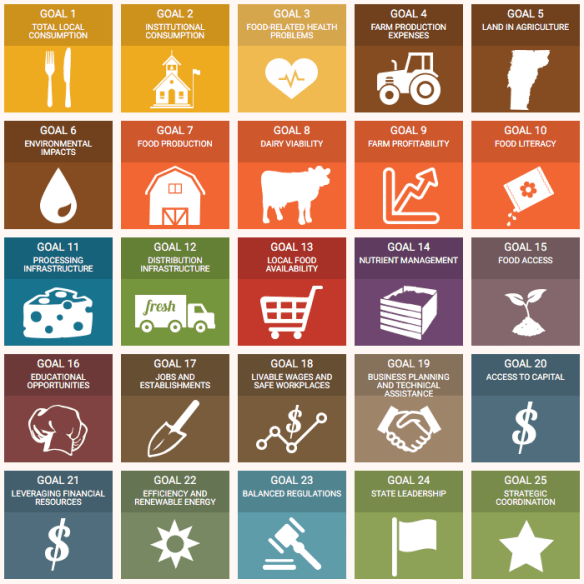
These are the 25 goals for Vermont’s Farm to Plate strategic plan. It makes sense to adapt this for our own purposes and part of the conference will be about shaping up some of these goals in the Northland context. A sustainable food system in Northland has to be grounded in our Treaty partnership, so we will make some room for one or two goals specifically focusing on kai Māori.

Notice that many of these goals are focused on commercial food production and distribution, others are about food related aspects of social and environmental sustainability and others are about policy.

Which of these goals motivate you? If you can see yourself being involved in promoting one or more specific goals, please contact us. You can leave a comment below, or contact Jeff Griggs, Clive McKegg or Peter Bruce-Iri.

A better environment and sustainable food systems

We waste too much food because it is too cheap according to Jason Clay, the Senior Vice-President for Market Transformation at the World Wildlife Fund. If we were to include the cost of the impact of food production (the externalities) food would cost twice as much. The World Wildlife Fund was established over 50 years ago to protect nature, but faced with the enormity of the task, 20 years ago they determined that food production  was the biggest threat to biodiversity.

“the single largest threat to every place is where and how we produce food”

In his 2010 Ted talk Jason Clay identified that 300 to 500 companies control 70% of the connections between producers and consumers in each commodity. Just 100 companies control 25% of that trade. These companies are typically motivated to optimise their profits and the food supply chains continue to get longer. As value is extracted in the middle of the chain, the rewards for producers diminish. Ironically and tragically, millions of small farmers don’t have enough food.

jason-clay-ted

The bottleneck in food systems (from Jason Clay’s TED talk, 2010)

Jason Clay’s thinking is directly relevant to Northland and our move to more sustainable food systems. We want to see more local producers, less processed food and closer connections between producers and consumers.

The other important work for the World Wildlife Fund is working with inefficient  producers that tend to create more damage environmentally and the failure of governments to enforce regulations – again relevant in Northland.

Jason Clay is in New Zealand now. Listen to Kathryn Ryan’s interview here. Here is his 2010 TED Talk.

Free fish heads

Here is a great example of software facilitating better resource use. The ability of software to facilitate direct connections between producers and consumers are important in developing more sustainable food systems – in this case, reducing food waste.

Free Fish Heads from Tightlines Television on Vimeo.

Here is a link to Free Fish Heads.

Kaiora honey

Manuka honey has enabled the Murray whanau in the Far North to re-establish a strong economic base back on their rohe (tribal lands). The story of Northlanders re-establishing their cultural and economic base on the land is a important and encouraging step in our move towards sustainable food systems.

kaiora-honey

Their story is told in this Country Calendar feature. (Note that the episode is incorrectly labelled on the TVNZ website). You will need to register to watch it.

Tae Murray returned to the north a qualified bee-keeper and his sister Blanche studied business and project  management. The rest of the whanau came back home to join the business. Kaiora Honey is now a thriving business exporting high value honey.

Manuka honey earns a huge premium in the international marketplace based on its health-giving qualities. The sought after healing properties of manuka honey are quantified in the unique manuka factor (UMF) rating indicated by the concentration of leptosperin in the honey.

Manuka and kanuka were once characterised as scrub, to be slashed or burnt to make way for pasture. The honey’s new status as a superfood is changing the dynamic of the landscape throughout New Zealand. People are now doing what was unthinkable a couple of decades ago, and replanting manuka. It is a pioneer plant that rejuvenates the soil and is many times more effective at sequestering carbon than pasture. As manuka and kanuka stands are enhanced, we have the opportunity to enrich ecosystems, protect waterways, and rejuvenate communities and local economies.

Here is Dr Josh Axe outlining the benefits of manuka honey.

And here is the article he refers to about the benefits of manuka honey. They include:

  1. reducing reflux and balancing the digestive system
  2. treating acne and eczema
  3. treating staph infections
  4. healing burns, wounds and ulcers
  5. healing tooth decay and gingivitis
  6. relieving inflammatory bowel disease
  7. boosting immunity
  8. relieving allergies and sinusitis
  9. improving skin tone and texture
  10. improving sleep.

Co-operatives

Ken Ross returned recently from Italy excited about their co-operatives. The Emilia Romagna region is one of the most prosperous in Europe and the home of luxury car manufacturers, Ferrari, Lamborghini, Maserati and Ducati. It has a population of 4.5 million with two out of every three citizens in co-operatives. This Prezi has more background.

emilia-romagna

This map of Emilia Romagna shows the range of produce common in the region. Click here for a larger image.

The roots of the co-operative movement in Italy were in the nineteenth century. Visionaries promoted collective economic enterprises, not based on individualism and self-interest. In this interview, Italian academic Vera Zamagni also identifies socialist and Catholic foundations for the movement. More recently, Article 45 of the Italian Constitution, lays a solid policy foundation for co-operatives, for example, one person, one vote.

Vera Zamagni identifies four types of co-operatives.

  1. User co-ops – for collective access of goods and services.
  2. Producer co-ops –  such as farmer co-ops.
  3. Social co-ops – delivering personal services such as health services.
  4. Worker co-ops – where workers supply capital and participate directly in management.

New Zealand agriculture has a strong co-operative tradition, but without the constitutional protection of “one person, one vote” these typically evolve to control by a managerialism with a consequent alienation of members. Faggiola is one example of co-operative food production in Northern Italy.

“…cooperatives tend to humanize the market because of their rules of functioning: the person – the member – is at the centre, not capital”. (Vera Zamagni)

Fruit and nuts unlimited

Earthcare Education Aotearoa are finding inspirational stories about local food across Aotearoa (New Zealand). Their latest video explores plantings of fruit and nut trees in public spaces from 50 locations around the country. This video introduces the project.

Fruit & Nuts UNLIMITED! – TRAILER from The Localising Food Project on Vimeo.

Here is a link to their Pledge Me site to fund the project.


Kaicycle- food waste recycling

Wellington’s Kaicycle is supporting the shift to sustainable food systems with urban food waste recycling. They use bikes to collect organic waste from homes and businesses, compost it, and use that compost to grow food. Half of that food is given away to organisations such as Kaibosh.

It is inspiring to see sustainability embedded in their business model. Their bikes make their operation carbon neutral, they reduce organic waste going to landfills, and grow food to provide better access for those in need.

Here is a Radio New Zealand interview about Kaicycle.


The Gocks save the kumara

Here is a short video from Loading Docs featuring the Gocks and their story as refugees. When kumaras in the Northern Wairoa were afflicted with black rot, Joe and Fay Gock provided new disease free kumara from their Mangere farm.

http://loadingdocs.net/mrandmrsgock/

https://vimeo.com/176540653

Hear more about them from this Radio New Zealand podcast. This is a timely story about the positive influence of refugees in the country that gave them a fresh start.